

Things Are Cheaper (If You Know Where to Look)
5 Idea Wednesday: deflation abounds; 'cheapest' model isn't the cheapest model; private credit's other problem child; China's beggar thy neighbor; Still no housing shortage (nor renovation boom)

5 Idea Friday Wednesday
there’s deflation, just not in the CPI (and other reflections on low prices that may not be low forever)
open weight models may be cheaper, but that doesn’t mean they’re cheaper
private credit’s other problem child
China continues to Beggar It’s Neighbors, but maybe less-so (possibly)
still no housing shortage, nor renovation boom, neither (and other tales from the housing market, where liquidity tells the story)
👉👉👉Reminder to sign up for the Weekly Recap only, if daily emails is too much. Find me on twitter, for more fun. 👋👋👋Random Walk has been piloting some other initiatives and now would like to hear from broader universe of you:
(1) 🛎️ Schedule a time to chat with me. I want to know what would be valuable to you.
(2) 💡 Find out more about Random Walk Idea Dinners. High-Signal Serendipity.1. Certain Things Are Cheaper (For Now), If You Know Where to Look
The recent CPI print has put some of the teeth-gnashing about raising rates to bed (even if it really shouldn’t matter, one way or another).
Random Walk continues to maintain that if monetary policy is not the problem, then monetary policy is not the solution. In this case, if the AI buildout is driving up the costs of technological components (and it is), and the impulse is driven by the spending decisions of some of the largest, most profitable companies the world has ever known (which it is), then the obvious cure to high prices is high prices.
For what it’s worth, Goldman Sachs agrees with me:
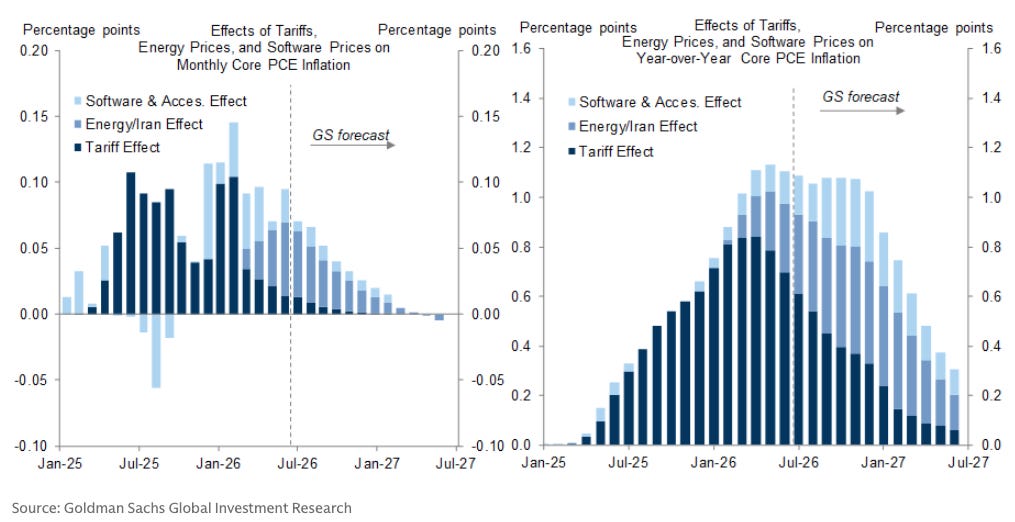
The combined price effects of tariffs, energy prices and tech hardware demand are expected to fade over the next year.
Putting that aside, I have this half-baked theory about why self-correcting inflationary pressure is still raising the hackles of at least some members of the Fed (other than the fact that letting everyone knows you’ve got hackles is the counter-Walsh tantrum de jour).
It occurs to me that perhaps part of the disconnect may arise from a feature of how we measure inflation.
You see, ordinarily, the reason that non-monetary (and non-fiscal) inflation is self-correcting is that higher prices suppress demand—either for the thing itself, or for some other ‘nice to have’ that gets squeezed out by the more expensive ‘need to have,’ (aka, ‘the cure to high prices is high prices.’) In the latter case, one component of the CPI may rise, but then another should fall. One inflation is offset by another deflation.
There’s deflation, it’s just not measured by the CPI
In this case, however, while that’s indeed what is happening—one price rises, while another one falls—it turns out that the deflation is not a measured component of the CPI (or PPI).
That’s because the thing that’s deflating are asset-prices:
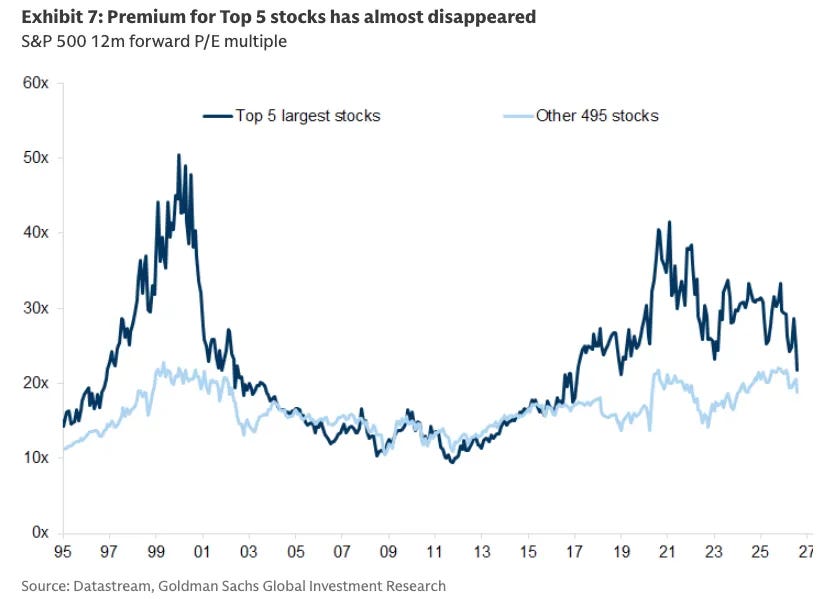
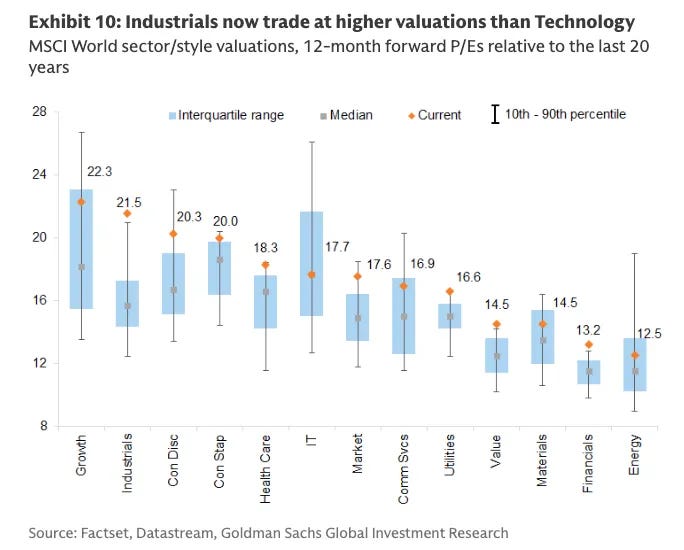
Tech multiples, especially for those companies driving up the cost of memory etc. with their considerable outlays, have compressed to the middle of their historical ranges.
In other words, all that capex is driving the price of memory up, and the price of hyperscaler equity down. Put yet another way, the high price of “need to have” AI infrastructure has soaked up all the free cash flow, such that it’s squeezed out the “nice to have” of returning money to shareholders (mostly via buybacks).
One price goes up, and another one goes down. Self-correction working just fine.
But, here’s the thing: the price of equity is generally not a component of measured inflation—the component that comes closest is asset management fees (as a % of AUM), but they’re a relatively small piece of the puzzle. Now, there are plenty of good reasons why we don’t think of asset prices as part of the CPI, but in this case, it remains the case that the feedback loop of demand elasticity is functioning, just not within the usual framework for how we measure it.
And I think that it may be obscuring an important part of the inflation picture. Over time, the rising cost of capital should itself soften the appetite for spending (so the theory goes), but probably not on any timeline that would make 2% benchmark-watchers satisfied.
Idk. It’s a theory, and I’m not sure why it’s wrong per se (even if it might be), so much as “that’s just not how we measure inflation.”
Discount on aisle hyperscaler
Anyways, there’s another reason to bring this all up: it’s once again worth noticing that the largest, most-profitable companies the world has ever known are kinda cheap:
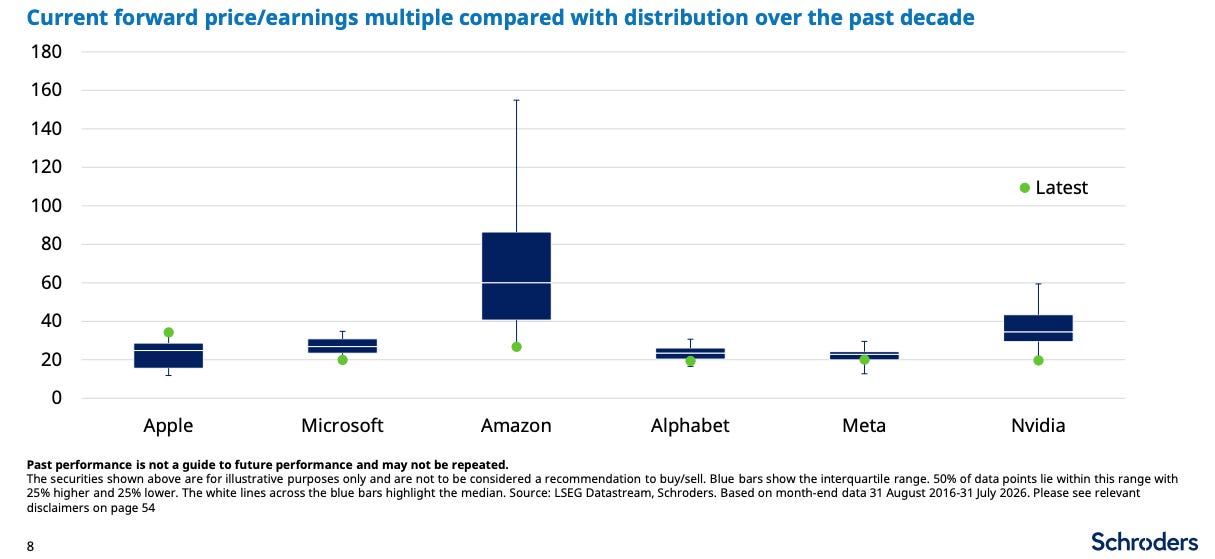
Other than Apple (which has largely opted out of the capex game), forward earnings multiples for ‘big tech’ are at or near the bottoms of their 10-year ranges.
On a monthly basis, the picture is largely the same, although Google is actually above its 10-year median and average:
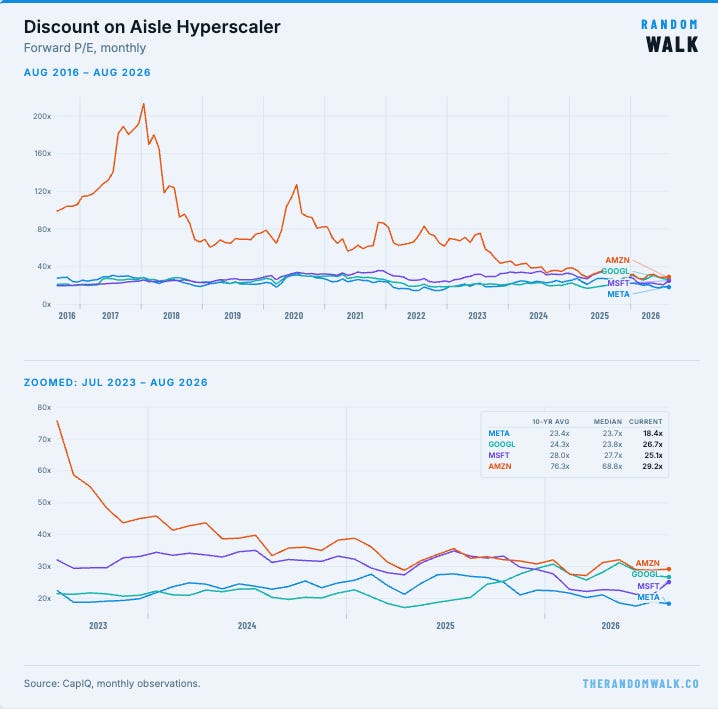
Google re-rated off the Deepseek sell-off towards the end of ‘25, and while it’s come down from its peak, it’s still somewhat elevated relative to the historical norm. But Meta, Microsoft, and Amazon share prices are definitely feeling the cashflow burn.
The reason, of course, that these companies are so discounted is the point above:
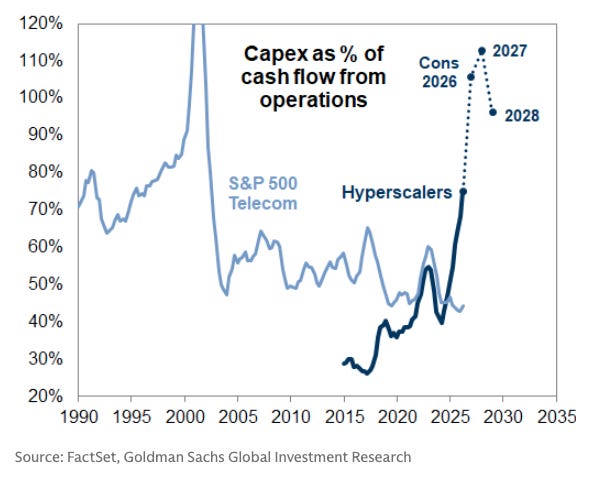
Capex is expected to exceed 100% of cash flow this year and the next. That’s a lot of cash flow that’s (a) not being returned to shareholders; and (b) flowing into the AI infra coffers . . . and so investors are putting their dollars elsewhere.
It’s either short-termism, opportunity cost, or fundamental skepticism about capex payoff, but either way, hyperscaler equity is trading for a relative song. (Another possibility is that investors are concerned that AI cloud is just a less-profitable business than non-AI cloud and therefore a re-rating is the new-normal.)
That’s part of why this is perhaps one of the most consequential charts in equity pricing right now:
