

When to cut bait?
At what point does one conclude that a fund's performance is what it is

Random Walk has officially signed-off for Passover, but I queued up a few posts to tide you over.
a preface: the game done-changed for everyone
show me the money (pretty please)
when to cut bait and/or how do you know when a fund is what it is
👉👉👉Reminder to sign up for the Weekly Recap only, if daily emails is too much. Find me on twitter, for more fun. 👋👋👋Random Walk has been piloting some other initiatives and now would like to hear from broader universe of you:
(1) 🛎️ Schedule a time to chat with me. I want to know what would be valuable to you.
(2) 💡 Find out more about Random Walk Idea Dinners. High-Signal Serendipity.When to cut bait?
Let me preface with a caveat that this is not a dunk on Venture.
Most, if not all, of the “doomer” observations about VC are applicable to the capital markets, more generally.
the game-done-changed for everyone—a dramatic shift in the cost of capital will have that sort of effect;
the end of an 80-year demographic tailwind to growth, applies everywhere;
a buy-high-sell-not-as-high bid-ask overhang, causing a pile-up of unsold assets, a deeper “j-curve,” and thereby a dry spell for liquidity, is every manager’s and allocator’s problem;
that that dynamic has lead to increasingly concentrated capital in the largest of funds (who are making increasingly concentrated investments in the largest of companies), and correspondingly tough-sledding for smaller managers, is true in PE, Real Estate, Credit . . . the works.
There’s obviously some nuance there, but if you were to observe the underlying challenges in VC that are downstream of a major cyclical regime-change, and conclude “something is wrong specifically with VC,” then you’d be more wrong than right.
If anything, VC with its uniquely pareto-like distributions, and bias towards technology (which will certainly define the next cycle), makes it a relatively attractive buy-fear-sell-greed opportunity, in Random Walk’s humble opinion.
Show me the money (pretty please)
Throat-clearing out of the way, this is a very striking chart, as it pertains to the deepening of the j-curve, for VC in particular:
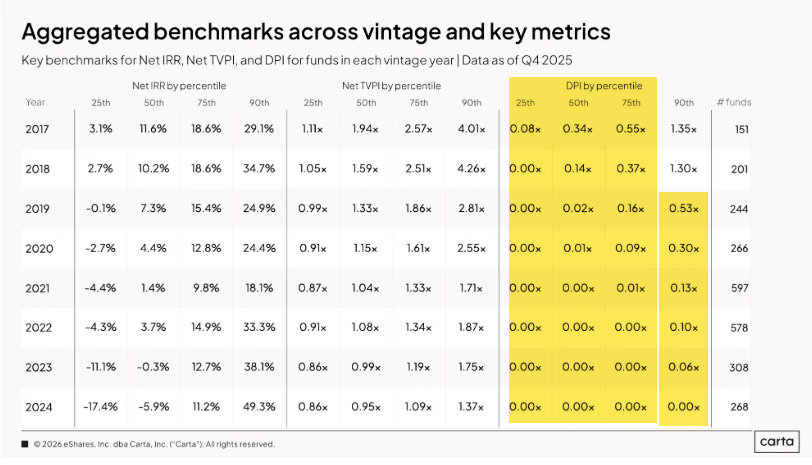
The only two categories of VC funds to have DPI > 1 (i.e. returned more cold-hard-cash than received) are top-decile funds from the 2017 and 2018 vintages.
That’s it. Every other LP is still waiting for their payday. The point being that allocators to even the very best of funds have gone an awfully long time without seeing their money back.
