

The hottest thing in employee comp, and other labor market missives
20+ charts on the current state of labor market things

the old job-maker is the new job-maker, same as it ever was
it’s the immigration, right? some unexpected things about the push-me-pull-me supply-and-demand of foreign born inflows
builders running out of workers . . . and customers
home healthcare work is (still) the job of the year, but supply is catching up to demand
the hottest thing in employee comp
college grad malaise
down the Beveridge Curve we go we go
👉👉👉Reminder to sign up for the Weekly Recap only, if daily emails is too much. Find me on twitter, for more fun. 👋👋👋Random Walk has been piloting some other initiatives and now would like to hear from broader universe of you:
(1) 🛎️ Schedule a time to chat with me. I want to know what would be valuable to you.
(2) 💡 Find out more about Random Walk Idea Dinners. High-Signal Serendipity.The hottest thing in employee comp, and other labor market missives
Buckle up.
Healthcare makes all the jobs (bc obviously)
Another day, another jobs release, and the story remains the same:
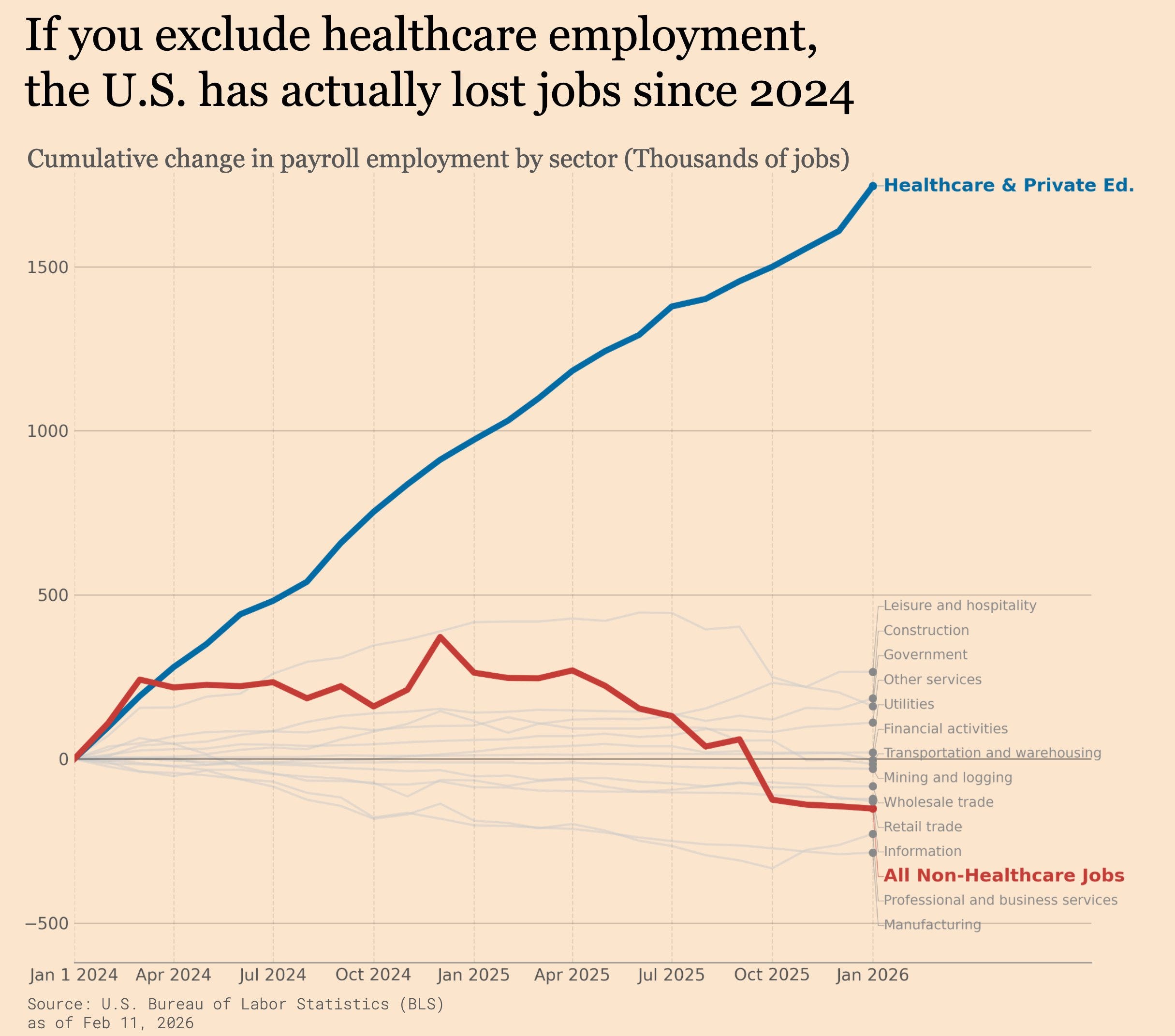
“If you exclude healthcare, the US has actually lost jobs since 2024.”
2024 is a bit of an arbitrary end-point, but the point stands, same as it ever was: Healthcare Makes All the Jobs.1
Expand the range to the past decade, and the story isn’t all the much different:
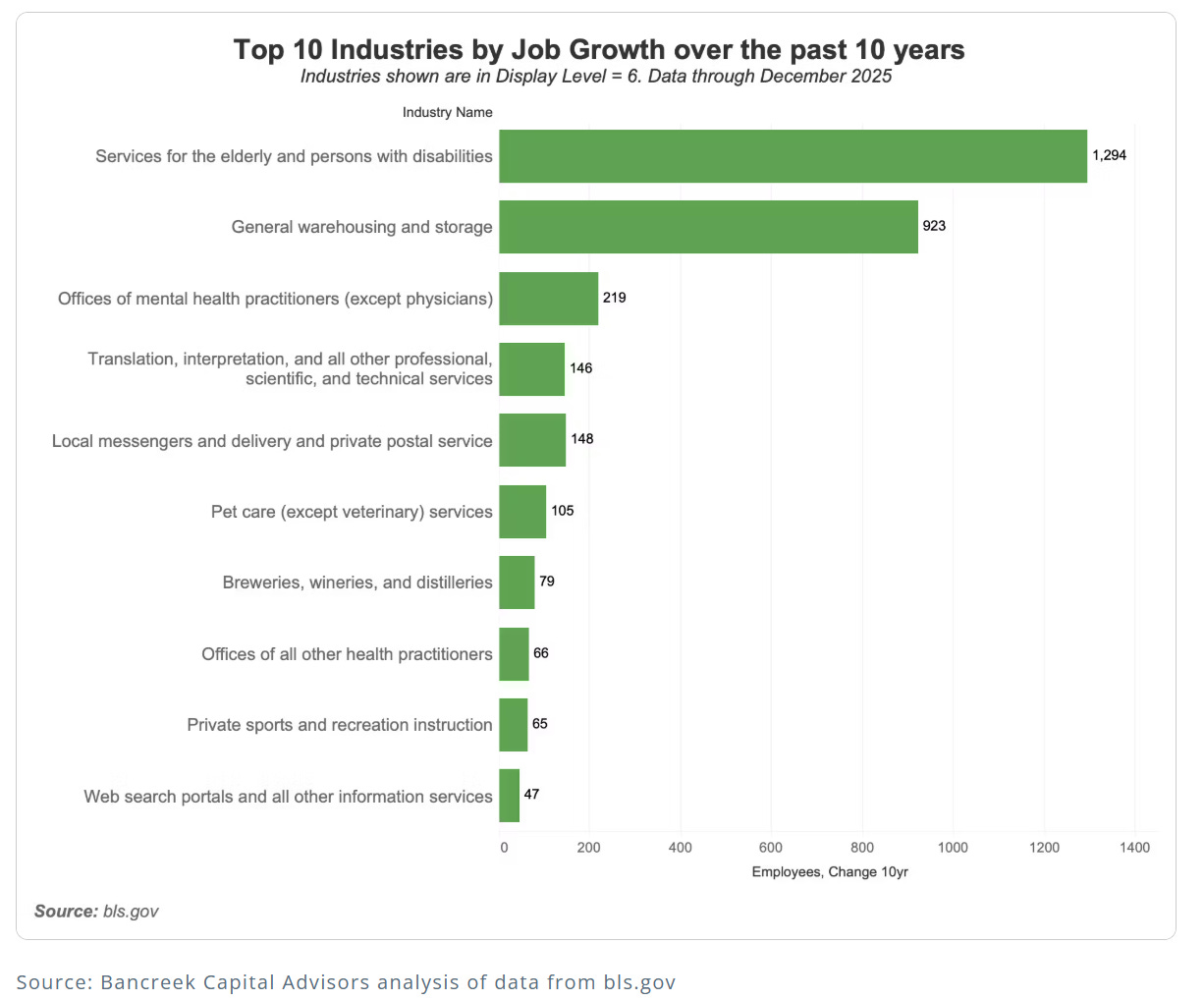
The Top10 Industries for job growth are old folks services, ecomm-stuff, and a smattering of pets, booze, and tech.
In other words, the jobs economy is fairly described as services for lonely, stay-at-home seniors and their pets.2
This is one of Random Walk’s longest running themes that was first mocked and scorned, and now, well, it’s just widely accepted reality. We’re getting older, and the customer has the national credit card on autopilot.
Unsurprisingly, job-growth was predominantly lady-driven:
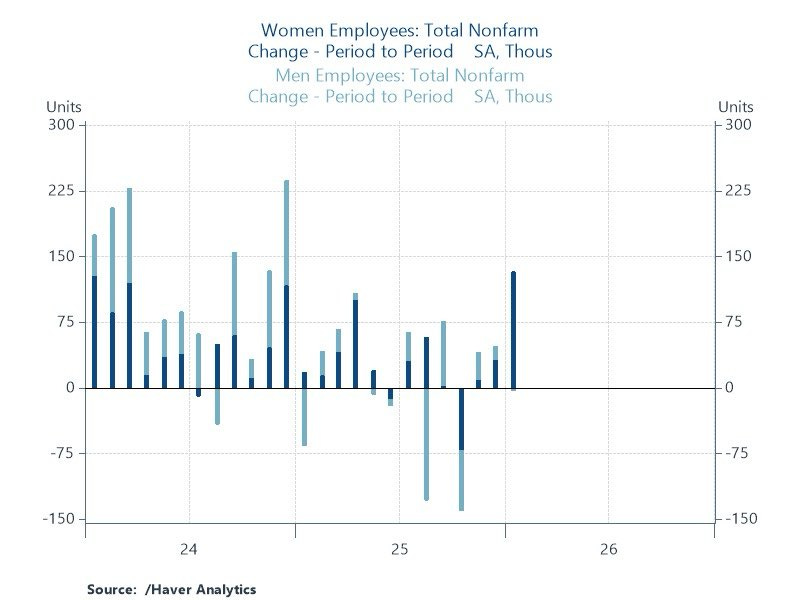
All the employee gains were made by women, while total male employment dropped.
Healthcare as an industry skews female, so healthcare hiring does too.
And, in an economy with basically one pro-cycle firing (i.e. AI), and otherwise preoccupied with an acycle (i.e. aging), it’s unclear where additional demand for workers comes from (other than healthcare). And that’s been true for a while . . . job ‘growth’ was really job ‘catch up,’ and as the gap closed, so too did the number of ‘new’ workers.
ICYMI


It’s immigration, right?
Naturally, the other thing that’s going on here is the drawdown in new arrivals.
Or rather, it’s definitely the case that new arrivals were the driving force behind employment gains, mostly filling the gap left by retirees.
Whether new arrivals create their own demand for new labor, I suppose, is a separate question, but either way, there isn’t that much evidence that demand itself has increased (and, again, that’s been true for a while):
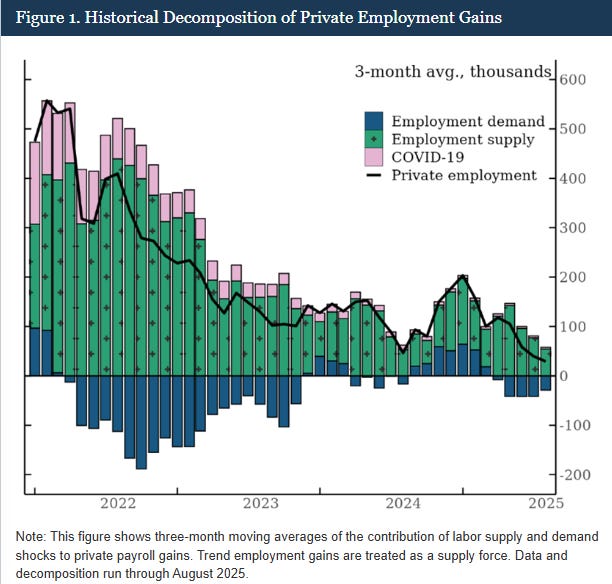
Employment gains have been driven almost entirely by additional supply, since the post-pandemic recovery began (according to this Fed model).
The way this model works is basically to look at job growth and wage growth at the same time.
If jobs increase, and wage growth slows, that means job-growth is supply meeting demand.
If they both increase, that’s expansion for both supply and demand.
If wages grow ahead of job growth, then demand is in the driver seat.
In this case, increasing job growth combined with decreasing wage growth imply that new labor supply (by far) was the principal driver of employment growth. Demand though, has been mostly negative (because otherwise wages ought to have kept on rising, or at least, not have decelerating quite so dramatically).
In other words, the Open Border was deflationary, in that it lowered the cost of service workers by closing the retiree-aging-driven “worker shortage.”
So, perhaps the border was closed just-in-time, i.e. the labor market was hitting a saturation point, and had we kept adding migrants, they would have been increasingly unemployed.
Another possibility is that migrants themselves are a source of new demand (and by closing the border, that demand was knee-capped). That would make migration a sort of infinite money-glitch (a theory that has not (yet) been born out in Canada, or Europe, fwiw), but certainly adding people, is well correlated to adding GDP.
Interestingly, one possibility is that newcomers create their own demand, but not in the way that people conventionally think.
