

AI-Beneficiaries-in-Training
Trying to identify some companies spending today, for results tomorrow

taking a massive bet on AI, without taking any bets on AI
first you must believe
follow the R&D
a sector with a tech stack, ripe for an overhaul
blockchain, blockchain, blockchain (really)
👉👉👉Reminder to sign up for the Weekly Recap only, if daily emails is too much. Find me on twitter, for more fun. 👋👋👋Random Walk has been piloting some other initiatives and now would like to hear from broader universe of you:
(1) 🛎️ Schedule a time to chat with me. I want to know what would be valuable to you.
(2) 💡 Find out more about Random Walk Idea Dinners. High-Signal Serendipity.Continuing to ignore the main story in the timeline to surface other interesting things, of note.
AI-Beneficiaries-in-Training
One of the many interesting puzzles about today’s market is that despite the near trillion dollars spent on AI infrastructure, investors are pricing-in almost no downstream benefits of AI.
All the returns are flowing to the picks n’ shovels making the transformational technology possible—a trillion dollars’ worth of invoices will have that effect—but for the transformees, the net-present-value of their future cashflows is either flat, or worth less than before.
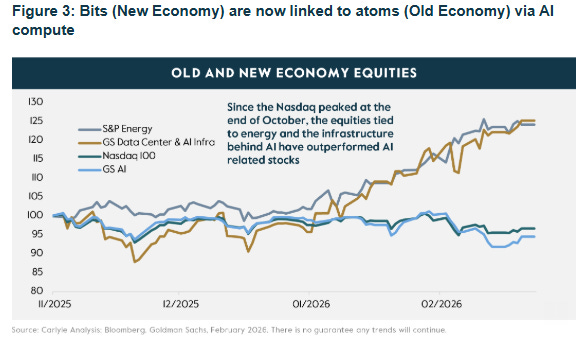
The Goldman “AI Basket” is stumbling along with the rest of the Nasdaq100, while infrastructure runs away from the field.
And that’s strange.
Random Walk has made this observation before, but it bears repeating, because the zeitgeist doesn’t seem to get it yet: investors are making a massive bet on AI, while making basically no bets on AI.
Why might that be the case?
One possibility of why that may be is some combination of uncertainty and opportunity cost. We don’t know who the transformed winners will be, but we do know who the transformers are, so investors are placing their chips accordingly. Who has time to speculate about two AI adopters in the bush, when you’ve got plenty of semis and turbines in the hand?
Another possibility is that, in fact, the transformers are, and forever will be, the only winner, either because (a) the AI buildout is like an expensive meal that no one will eat, but still must be paid-for; or (b) the buildout is the new tollbooth for what will simply be a ubiquitous higher cost of doing business, going forward. Companies will be transformed, but the relative value-capture lives at the infra layer.
I’m sure one could come up with some other possibilities, but for present purposes, here’s the point: of these three possibilities, there’s really only alpha in one of them: option #1—there will be transformed winners, we just don’t know who they are yet.1
ICYMI


First you must believe
Markets have already priced-in accelerated growth for the buildout (although perhaps not enough, or perhaps too much), so, at this point, to be early in the AI trade, one has to anticipate some other acceleration, ideally before it shows up in earnings (or at least before those earnings are reported to the street).
It sounds obvious (because it surely is), and yet, for the most part, there really aren’t any companies trading on the promise of growth-to-come-but-not-yet-started.
And yes, one has to believe that AI/Tech will, in fact, lead to acceleration . . . because otherwise, why all the Capex, but also, because it does not seem that hard to believe:
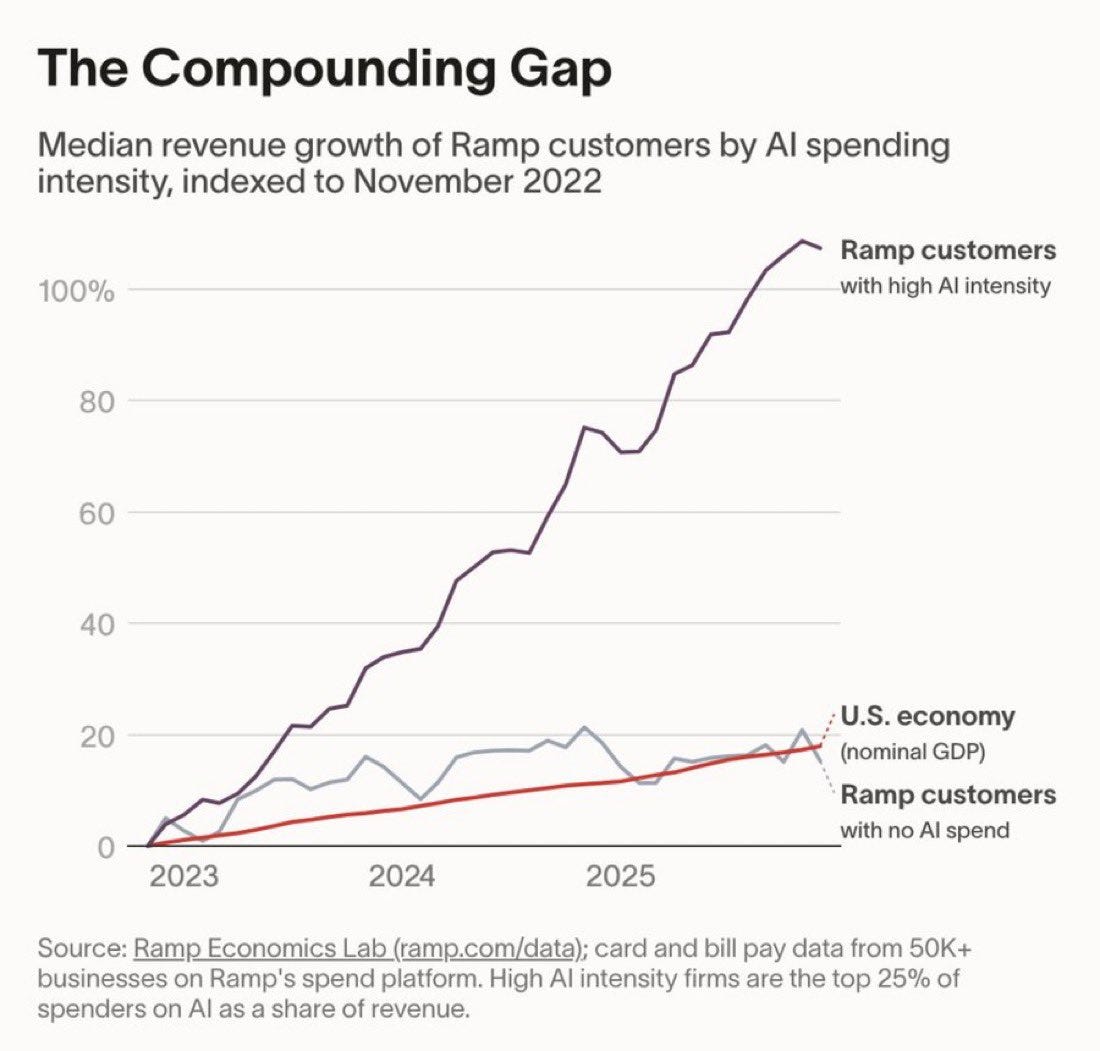
Ramp’s spending data shows a very striking divergence between those spending on AI and those that are not: the former are growing much more quickly.
There is definitely sample-bias here, and it’s not obvious which direction causation runs.
It’s also possible that high-growth companies are simply passing through AI costs at negative gross-margin, too, which is a neat trick to generate topline revenue growth, but obviously not a signal of sustainable AI-driven expansion.
Even more probably, it’s almost certainly the case that “AI companies” (who necessarily spend a lot on AI) are the high-growth companies because AI is the thing everyone wants to buy, but again, that doesn’t mean that “investing in AI makes you grow.”
Those are valid concerns, but for now, I’m going to accept the premise that AI does, in fact, have some properties of a wonder-drug.
So, it got me thinking: who is investing in AI today for benefits that will materialize sometime tomorrow. It’s an obvious question, that nonetheless, markets have left entirely unanswered.
Follow the R&D
That question too, lends itself to, at least, two categories of companies that might fit the bill:
