

Citrini asks all the wrong questions, mostly
Chiming in on the current thing, but smarter

Citrini’s ‘thought-experiment’ raised at least some interesting questions, but mostly not
The two main flaws . . . lol, frictionless? A productivity boom without a surplus?
What really matters: a great rotation and the greatest tailwind coming to an end
👉👉👉Reminder to sign up for the Weekly Recap only, if daily emails is too much. Find me on twitter, for more fun. 👋👋👋Random Walk has been piloting some other initiatives and now would like to hear from broader universe of you:
(1) 🛎️ Schedule a time to chat with me. I want to know what would be valuable to you.
(2) 💡 Find out more about Random Walk Idea Dinners. High-Signal Serendipity.1. Citrini asks all the wrong questions, mostly
The current thing moves so quickly these days that this is a bit stale, but between snowdays and other commitments, I couldn’t wrap this up until today.
Anyways, I don’t really follow Citrini closely, but I’ve always generally liked what I’ve read, when I’ve read it. In case you didn’t already know, Citrini published a doomsday “scenario analysis” of “abundant intelligence,” or whatever.
Maybe people were stuck at home with too much internet on their hands, but Citrini unleashed havoc:
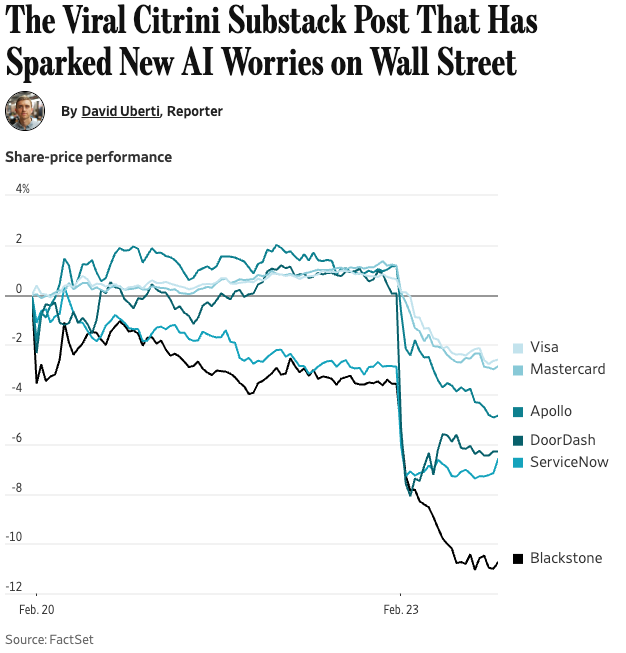
Companies mentioned in the post sold off en masse, well beyond the usual SaaS-Attack.
Visa? Mastercard? Who needs ‘em? AI agents are just going to use stablecoins and skip the fees.
Doordash? Well, AI agents don’t need a loyalty program, so that one is toast too.
Private Credit? Well, we know the story there…it’s a house of cards built on loans to software, and if software goes down, so too does Blackstone and Apollo.
Of course, it’s not just some companies that are toast, in this scenario.
AI Agents are going to do everything, dramatically lowering costs (yay!), but also deprecating the white collar workforce to paperweight status (boo!). Layoffs everywhere, spending and housing collapse, and everything goes to hell.
OK. Maybe I’ve missed some key parts, but that’s basically the gist of it.
Kudos to Citrini for a fun thought experiment that also happen to set the internet and the investment community on fire, at least for day. And honestly, the most bearish thing about the whole event is simply how flighty and mercurial the investment community can actually be, especially when the boat gets arockin’. (Or maybe we should just appreciate how seemingly stable and coordinated markets generally appear to be?)
As for the actual substance of Citrini’s post? Lots of people have already chimed in along similar lines, but the very short version is that I’m generally not sure what all the fuss was about.
I mean, none of it is that original. “AI will kill white collar jobs and incumbent software businesses too, and then everything built on that artifice implodes,” is pretty basic. I too have wondered whether the increasing onus on profitability leads to more headcount cutting, so there’s that.
On the plus side, I suppose it is interesting to think about how “agentic shopping” will impact payment rails (in some way other than “I gave the AI my credit card,”) but the more interesting questions are around search, brand, marketing, etc. (which Citrini doesn’t really get into at all).1 What’s an Agent-friendly UI/UX anyways? Likewise, if the previous tech titans were built on network effects, is there any comparable high-margin moat for the AI era?
It’s food for thought, for sure, but nothing worth updating one’s priors over, imo.
In terms of the flaws, well there are a bunch, but let’s focus on the big ones.
ICYMI


Compute is the opposite of frictionless
The first major flaw is that Citrini rests his scenario on a demonstrably false factual premise: the notion that “friction,” (i.e. the cost of compute) “goes to zero.”
In other words, the entire scenario is premised on the exponential growth of AI doing everything by directing AI to do everything, including all the decisions that humans might otherwise direct AI to do. In Citrini’s telling, AI replicates and scales at basically zero marginal cost.
And that’s just . . . exactly wrong?
Sure, inference is getting cheaper, but the whole reason that all this Capex is underway is to buy the GPUs (and generate the electricity) to run this whole shebang.
Model providers are routinely throttling users, and almost certainly subsidizing all the silly image and video creation to further adoption.
Every company and board member I’ve spoken with is actively thinking about token-cost as a rapidly rising expense item. My prediction is that it won’t be long before companies start to think in terms of “ROIT” (“return on invested token”).
If anything, rather than “friction goes to zero,” I’m more worried about a yawning gap between (a) the price of compute required for a sustainable OAI etc. business model; and (b) the price customers are willing to pay for the amount of compute required to routinely discover and deliver meaningful business outcomes.
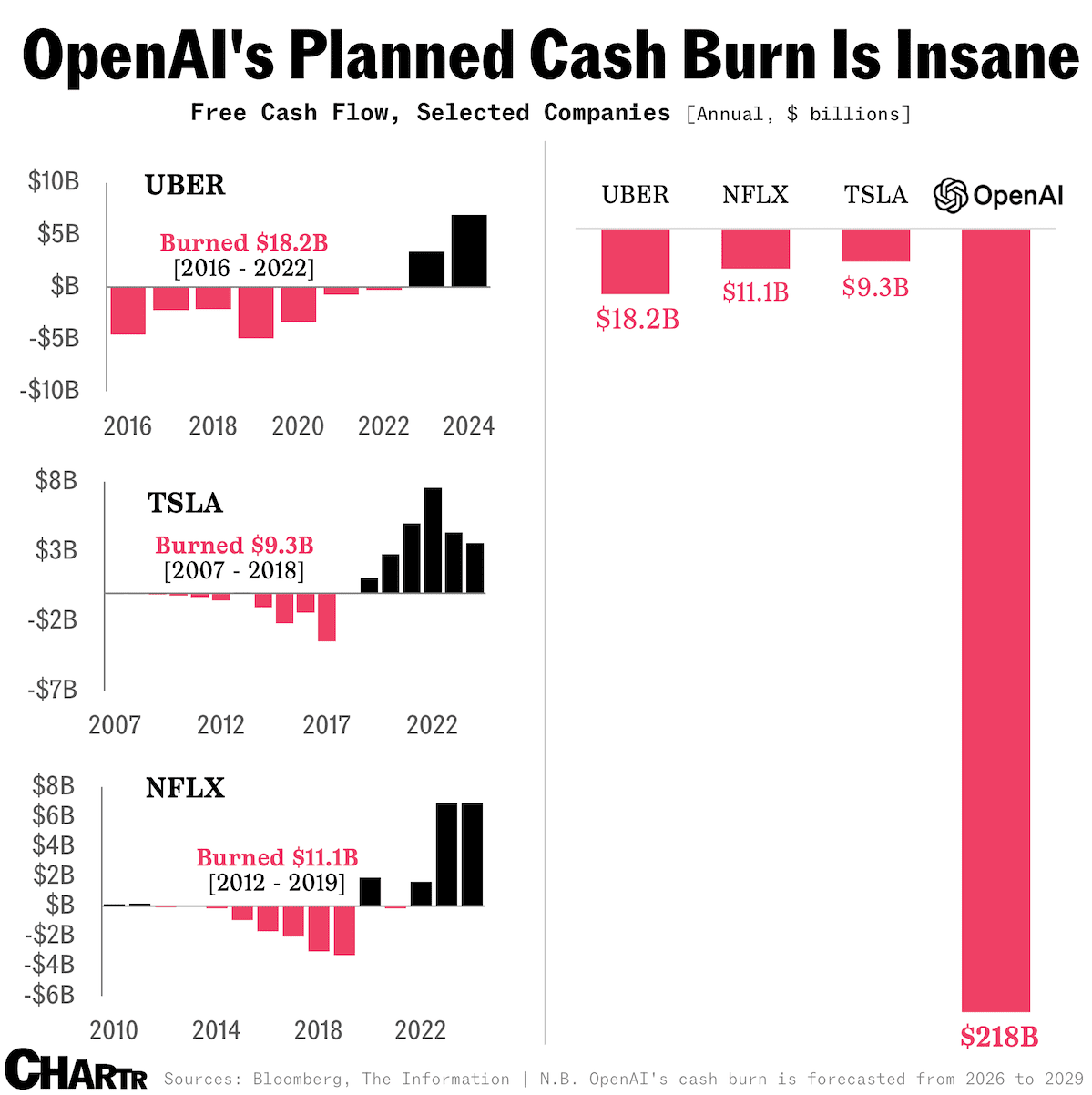
OAI cannot go on like this, mostly subsidizing consumer adoption at a staggeringly high cost.
Remember that AI is really only good at code, right now:
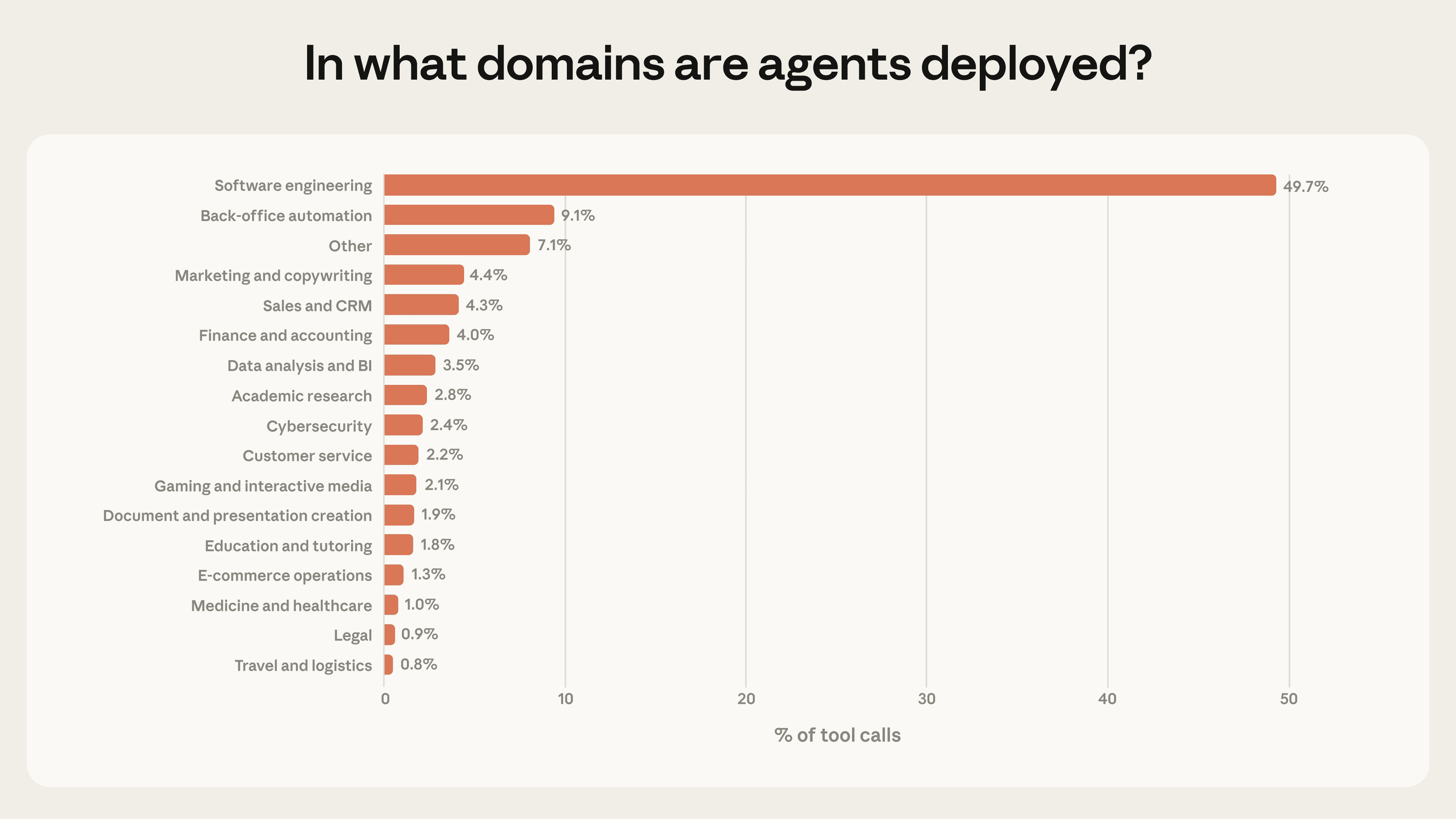
Software engineering is by far the dominant arena for agents, in Claude’s admittedly biased sample.
As any entrepreneur will tell you, writing code is not the same as building a sustainable business, product, or feature. Don’t get me wrong—it’s a very big deal, but if building a business was as easy as modeling one in excel, the world would be a very different place.
And AI, left to its own devices, is still pretty unreliable:
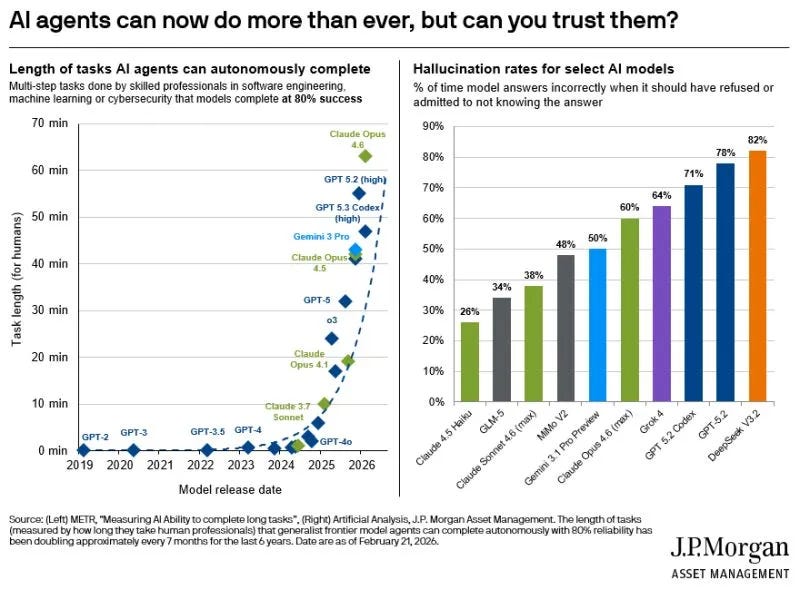
Model capabilities are improving exponentially (by one metric), but “hallucination” rates are still quite high.
Agents making things up 28% of the time (at the low end) isn’t going to put the white collars on the breadline, just yet.
An imperfect analogy would be to think of AI as currently in its luxury product phase. A private jet and/or one of those first gen clunky car phones might be justifiable for certain high-end users, but there may not be a “mass marketable” product, just yet. If models started actually charging for all the “friction,” I’d be concerned that adoption would slow dramatically.
Keep in mind that another iteration of that scenario is still bearish, but not in the ways that Citrini suggests.
Perhaps AI is ready for the mass-market, but again, given the definitely-not-zero friction of deployment, all the extra-value generated by AI is accretive to the model layer, and not the enterprises that deploy AI. When SaaS incumbents (or Walmart) eventually integrate AI, it accelerates growth, but it turns out to be relatively low margin growth because compute becomes a big chunk of net-new COGS.
That’s bearish for SaaSCos, but not for the economy writ-large (and certainly not for the hyperscalers and/or frontier models).
Or, alternatively, AI is ready for the mass-market, but competition between the model-providers (and the rapid depreciation of state of the art models that don’t stay state of the art for long, not to mention the depreciation of the underlying hardware) means that model-makers spend enormous amounts of money for what’s ultimately a commodity.
That’s bearish hyperscalers and model labs, but bullish SaaSCos and the economy writ-large.
For what it’s worth, there’s plenty of evidence of companies routing to less-up-to-date models for the jobs that those models can do, which means outdated models do retain value.
Plus, pricing for older GPUs looks pretty solid, too:
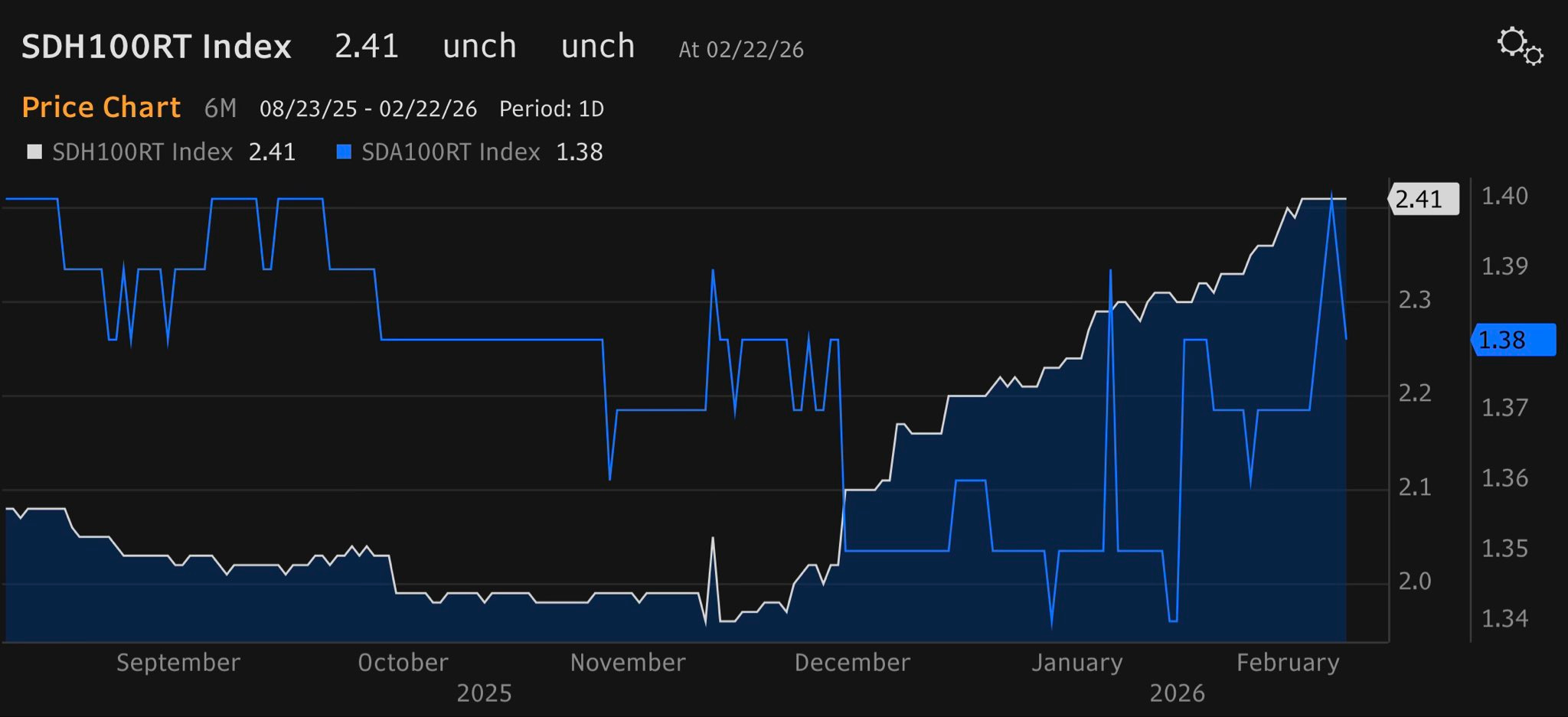
Rental pricing for older H100s and A100 GPUs perked up recently.
Anyways, the broader point is that this stuff is expensive—perhaps too expensive—and not that it’s not expensive enough.
Open Weight Challengers
Now, do Open Weight models present a challenge?
Yes, sure. If frontier models come out with the next great thing and far cheaper Open Weight models follow on their heels, then that’s an unwinnable game.
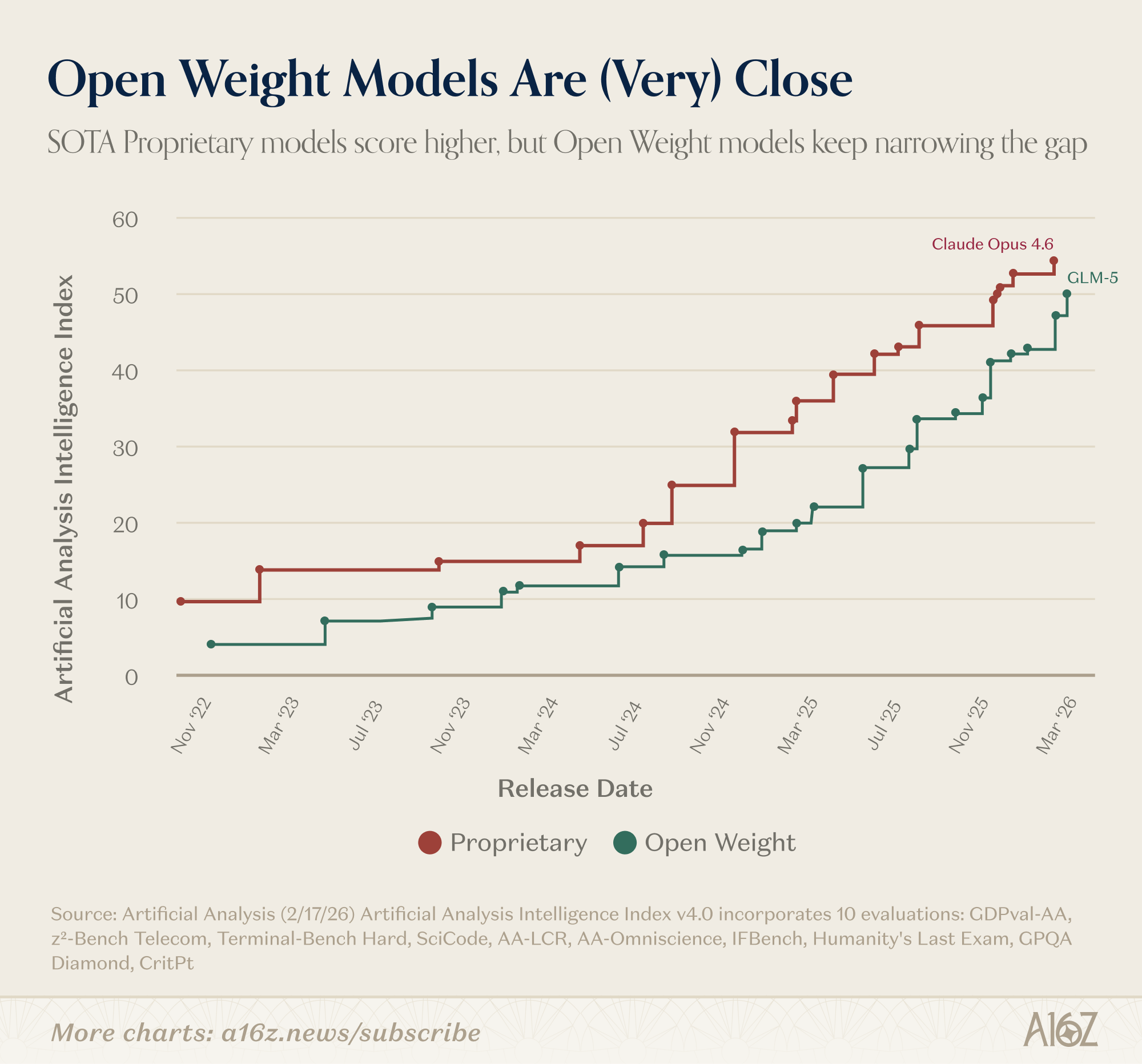
Open Weight models lag proprietary models on performance, but not by much.
That said, my strong suspicion is that the (Chinese) Open Weight model makers are just stealing (and Anthropic thinks so, too), and while there may be some karma involved, I would expect the labs to get smarter about this, and perhaps a legal-political solution may follow, as well.
But either way, the idea that AI scales infinitely without any marginal cost just seems absurd.
To the contrary: what makes AI different from software of yore is that it doesn’t replicate at zero marginal cost—using AI costs money, every time. That raises interesting questions around how to value AI-driven growth (and is it more like the asset-heavy cycles of beforetimes), but ‘what if it’s manna-from-heaven?’ isn’t really where I’d spend much time.
AI is a productivity unlock without a surplus?
The other big error is a conceptual one, or really just a failure of imagination.
