


check-in on entry-level hiring, some evidence of a thaw
is that why people hate AI? there are some wild sentiment splits
the real Gen GenAI (it’s not the Zoomers)
regime change makes tech both more and less important than ever
👉👉👉Reminder to sign up for the Weekly Recap only, if daily emails is too much. Find me on twitter, for more fun. 👋👋👋Random Walk has been piloting some other initiatives and now would like to hear from broader universe of you:
(1) 🛎️ Schedule a time to chat with me. I want to know what would be valuable to you.
(2) 💡 Find out more about Random Walk Idea Dinners. High-Signal Serendipity.Of Economic Regime Change, and Anti-Tech Sentiment
Some thoughts on the second-order effects of the outsized premium to doing more with less. It’s a somewhat speculative, long and winding tale.
Soft-hiring hits the new entrants hardest
Jobs day release last week was all over the place, so it’s really not worth trying to interpret it. This is as good a recap as any, but my instinct is just to say “noisy data.”
Elsewhere, however, there is some interesting data on one of the key labor market themes: the “broken” on-ramp, i.e. depressed entry-level hiring, especially for the college degreed.
It’s the one area of actual “softness” in an otherwise tight and supply-constrained labor market, where the existence of any slack whatsoever is worth considering. That’s by far the most significant aspect of the observation, but there’s some secondary import, as well. If you wanted to say “ai is a jobkiller,” then the decline of entry-level hiring is basically the only data you can point to and say “see, told you so.”
As for what it all means, to my mind, the pain for new entrants is downstream of general softness in demand, plus aging-in-place, combined with perhaps a small dose of misallocation. It’s also possible that remote work has created some optionality for firms, such that they can access talent all over the world, and therefore have less of a need for a steady pipeline of raw talent.
More simply, now that everyone is bottom-line oriented (and outside of AI capex and healthcare, secular tailwinds are hard to come by), the inclination to add payroll is muted. The negative effects of soft demand land on new entrants, first and foremost, and the fact that existing workers are working longer, only exacerbates the problem.
The St. Louis Fed recently published some research to that effect, i.e. job openings (as a proxy for demand), are most predictive of new-entrant participation in the labor force (for better and for worse):
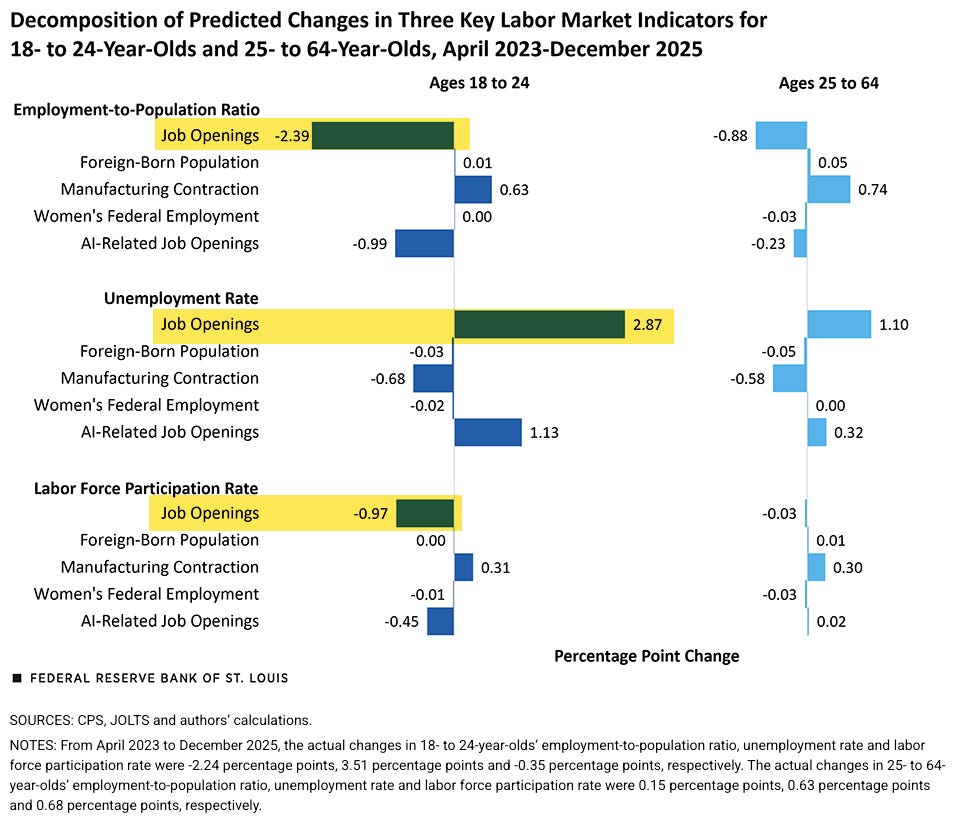
Downshift in job openings makes the biggest contributions by far to changes in all of employment:population, U/E%, and LFPR.
Basically, if firms aren’t posting new jobs, it’s the youngest members of the workforce, that feel it most acutely. When demand softens, firms don’t fire birds-in-hand to replace them with young blood—they just stop hiring young blood.
That’s the theory, at least, and it seems plausible, enough.
Entry-level Thaw?
The good news, is that there is more evidence that things are turning the corner.
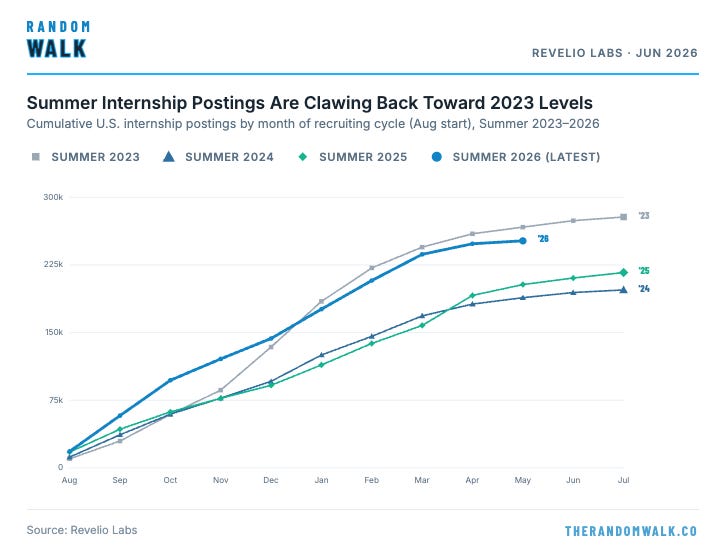
As per Revelio’s data, summer internships are tracking well-above the previous two years (with some pretty big gains for tech, so it’s not all low-paying work).
ICYMI


To be honest, I have no idea whether internships are a leading signal of anything, but more has got to be better than fewer, right?
And for those who would blame AI for the entry-level malaise, we’ve got some data for you too.
If AI was replacing the need for jr. hires, then how do you explain this:
