

Open For Open Weight Business
The Open v. Closed "Debate" Is About Something Else

Open v. Closed, a series of strawmen
has anyone actually made a well-reasoned argument about why the government shouldn’t intervene re. distillation?
the unconsidered tradeoff
what does Mr. Market think?
all chips on chips, but the discount presides
👉👉👉Reminder to sign up for the Weekly Recap only, if daily emails is too much. Find me on twitter, for more fun. 👋👋👋Random Walk has been piloting some other initiatives and now would like to hear from broader universe of you:
(1) 🛎️ Schedule a time to chat with me. I want to know what would be valuable to you.
(2) 💡 Find out more about Random Walk Idea Dinners. High-Signal Serendipity.The Open v. Closed Debate Is About Something Else
Last week, the Chinese AI lab Moonshot released an open-weight model called Kimi K3 that, for the first time, scored higher than the latest and greatest frontier model.
It’s a big deal because, among other things, if open-weight models are just-as-good-and-maybe-better than closed US models—and served at a fraction of the cost—then it calls into question the entire sustainability of the frontier lab approach. Quite simply, the OAIs and Anthropics of the world cannot continue to spend billions of dollars training new models, if those models offer minimal competitive advantage. That’s a big “if,” however, but let’s just take it as an underlying premise of the zeitgeist.1
Even then, there were still a few open questions:
is Kimi actually better? Is it actually cheaper? On which dimensions? What does “better” mean, really?
How did Moonshot pull this off, while spending far less on compute? Did they actually train a model at a fraction of the cost, or did they distill a model from Fable, i.e. prompt Fable to divulge its reasoning secrets, and use that to release a knock-off?2
Since then, there’s a bit more clarity, but also still more questions:
yes Kimi appears to be pretty good, and relatively cheap, but the reality of “cost per token,” is a bit more complicated than sticker price;
yes, Kimi definitely appears to be a distilled version of Fable, plus some differences, of course, but consensus is that distillation carried the laboring oar.
What happened next was a thoughtful, well-reasoned discussion “bombast,” and then “counter-bombast,” shortly thereafter.
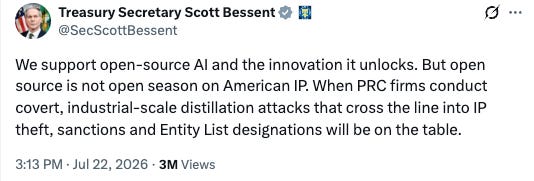
The initial bombast salvo came from the Treasury Secretary variously declaring that the US Gov’t was considering an effective ban on [Chinese] open-weight competition:
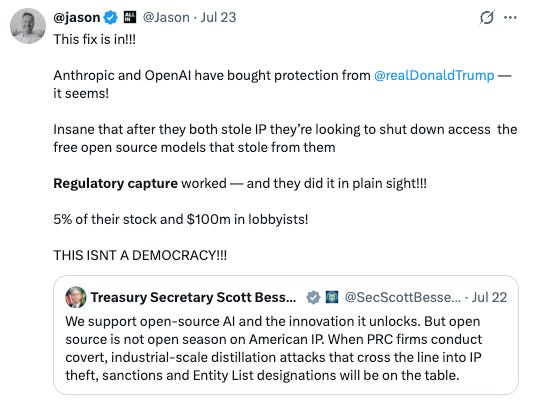
The counter-bombast came in the form of VC-posting, mostly accusing the big labs of seeking regulatory capture:
. . . and then eventually a joint letter, authored by Jensen himself, extolling the virtues of open-source competition. Since then, Zuck published an op-ed declaring AI for the Everyone (behind a paywall, no less), and the “yay, open source! boo labs!” discourse mostly continues apace. Mr. Market, too, appears to have some concerns about where this all may lead.
To my mind, these are all variously ships passing in the night.
ICYMI


No one has actually offered a real objection to a government intervention about distillation
The relevant debate isn’t really open v. closed.
It’s about whether something ought to be done about distillation, specifically the kind of distillation that most people seem to recognize as “a knock-off.”
And even there, rather than a sane discussion, what has transpired seems primarily anchored on whether one has a rooting interest in the possibility of mega-labs or not. Or rather, the vast majority of the criticism directed at team “do something about chinese distillation,” seems quite convinced that “doing something” is motivated by the labs’ desire to save their own skin, ergo, the critics seem to believe that “not doing something” spells doom for lab margins, which appears to be an outcome that they would rather prefer.
You, see what’s most important here is that I confirm my priors:
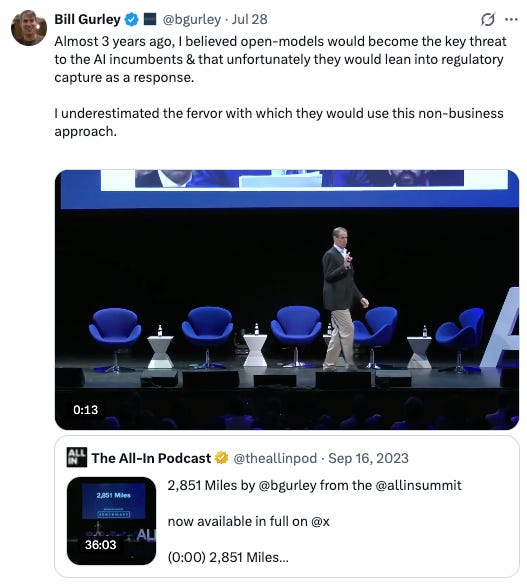
Yes, surely all that has transpired can be viewed through the lens of “I told you so.”
Nooo, Random Walk, you’re being unfair—this is an assault on the open source tradition! We are merely defenders of the open and free internet!
Really? Is Nvidia’s CUDA open-sourced? Lol, no. And Meta has been developing open models this whole time, and no kerfuffle ensued.
The issue is plainly not open v. closed.
It’s a specific kind of open, i.e. the kind that’s released by free-riding on the billions the labs spend on training. If Meta released a frontier open model tomorrow (or last year), trained on its own substantial dime, people might still be concerned about lab margins, but I’m fairly certain that the Treasury Secretary would not be involved.
If the Government does IP enforcement, that’s not unusual
OK, you’re right. It’s not really about open qua open. But, have you considered the horror of the federal government going out of its way to protect IP interests of individual companies?! And if there’s an IP interest, then why not articulate the specific cause of action?! IP is merely a facade for rote protectionism!
Wrong again. There are countless examples of the US Government leveraging its might to protect the IP interests of US companies, especially tech. Off the top of my head:
every movie you used to watch opened with the FBI warning on copyright protection, including the threat of prosecution;
counterfeit handbags are are routinely seized and destroyed at the border;
back in 2017-18, the government undertook a massive investigation into Chinese tech transfer and IP practices, which led to the first wave of tariffs on China;
back in 2007, the US initiated an entire WTO litigation around China’s incredibly lax IP enforcement regime (which it won);
the FCC just added advanced robotic devices and power inverters to the Covered List banning import sales
OK, you’re right again. It’s not that unusual for the government to take an interest in IP enforcement. But then what IP has been violated? What’s the theory?
This is a slightly better objection, but one that I find slightly puzzling, and ultimately, not that compelling.
It’s true that no one appears to have articulated an actual theory of distillation infringement. And yet, everyone seems to “know it when I see it” understand the difference between “this kind of distillation is fine—because I’m not just planning on releasing a knock-off frontier model,” and “uhhh, we wouldn’t do that kind of distillation bc it’s just a path to a knock-off and pretty obviously against the lab T&Cs.”
The best evidence that everyone seems to know it (other than my own conversations with people) is that US companies are not releasing competitive open-models that are, in fact, close knock-offs of the frontier models. I strongly doubt that US companies are incapable of such a thing, it’s far more likely that they fear the legal ramifications of doing so.3
The point here is that if people seem to be able to readily distinguish between “ok distillation,” and “definitely-not-ok distillation,” then there’s no reason that that the law can’t make that distinction, as well. And if it doesn’t yet, then it could, quite easily. Will there be some uncertainty at the margins? Yes, of course. There always is.
Should it? My weakly held prior says “yes,” as I’ve quipped before, if ever there was a time for IP lawyers to shine, that time is now. But, IP is not my forte, and neither is distillation, so I could be moved in the other direction (just not by the arguments presented thus far).
Yeah, but we really want cheap AI
So, to recap up until this point: clearly, the labs aren’t categorically opposed to open models, and it’s neither unusual for the government to take an interest in private IP rights, nor does it seem beyond the ken of IP law to circumscribe “bad distillation,” specifically.
So, why shouldn’t the US government get involved, here?
Fine. The real reason is that cheap AI is good. Why should the entire ecosystem be beholden to the labs? Just two companies to rule the world? And besides, karma’s a bitch—the labs trained on the world’s IP, so what goes around comes around.
Yeah, I get the Karma point, but (a) the labs are now paying for a lot of that training data; and (b) there’s a big difference between hoovering up zillions of diffuse and mostly worthless (on their own) data points, and just ripping a highly concentrated and very expensive undertaking from a single source. Plus, it’s not like the labs have no competition—Google, Elon and Zuck are hardly what anyone would call trivial upstarts.
Mostly it seems like you just want cheap AI in the same way that many of us used to enjoy pirated music, which, however unsympathetic the record labels may have been (and however much other odious lobbying they have done), wasn’t the most persuasive argument.
Basically, I find the general objections around “distillation is bad and the gov’t ought to do something about it,” to be pretty make-weight. Here’s a pretty good example, courtesy of Benedict Evans, of the sort of make-weight reasoning I’m referring to:
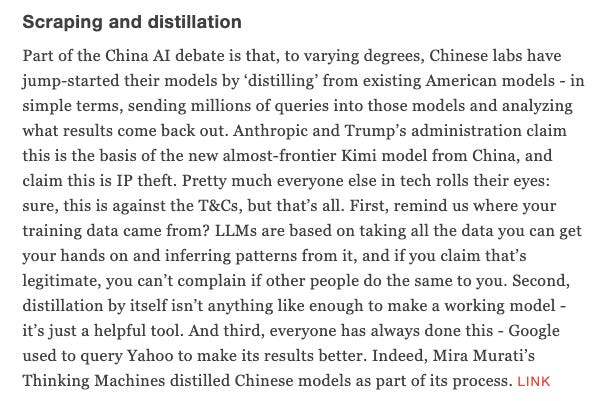
Tech “rolls their eyes” at the T&Cs? I mean, maybe they do, but they’re still not violating the T&Cs, and it’s sort of besides the point.
That other forms of distillation also take place, and yeah man, anything is distillation when you really think about it, is again, neither here nor there.
What we’re talking about is a specific kind of distillation that everyone appears able to distinguish as different from the other kinds, and they’re perfectly capable of not doing it, especially when they fear some repercussions.
There may be other reasons why this isn’t an IP enforcement fight worth fighting (or some other regime), but these don’t seem like it.
Some people (like my friend Gil Dibner) think distillation just can’t be stopped. OK, that’s a possibility. Other people seem to think Anthropic could stop it easily . . . if they were willing to cut off big paying customers. Idk.
The bigger thing unsaid and under-considered
OK, so the outrage directed at the proposed ban on Chinese open-weight models is poorly considered, and perhaps motivated by other things. Fine.
