

The Jobless Productivity Boom
Who could have foreseen such a thing?

the jobless boom: it was either a jobless boom, or a jobless bust, but ‘jobless’ was always going to be part of the picture
growth without growing: build data centers
hire lawyers
‘mind the supercore’
Is this a productivity boom, too? Well, if so, it started in 2018
what’s really happening
👉👉👉Reminder to sign up for the Weekly Recap only, if daily emails is too much. Find me on twitter, for more fun. 👋👋👋Random Walk has been piloting some other initiatives and now would like to hear from broader universe of you:
(1) 🛎️ Schedule a time to chat with me. I want to know what would be valuable to you.
(2) 💡 Find out more about Random Walk Idea Dinners. High-Signal Serendipity.The Jobless Productivity Boom
Bloomberg dropped a big story on the “unprecedented ‘jobless boom,’” and y’know, that’s a thing around these parts:
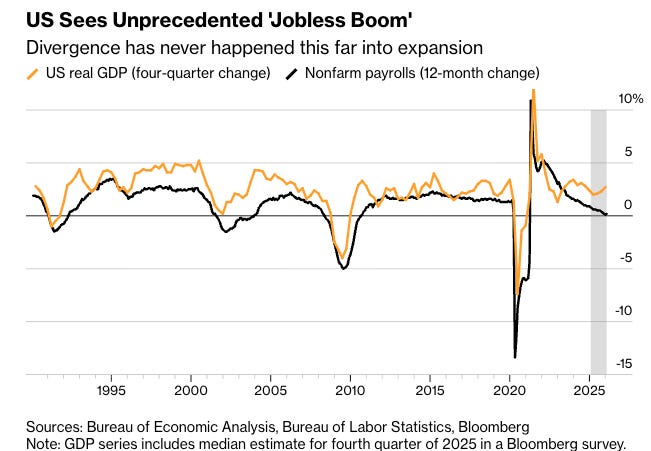
Forecasters expect Friday’s report on gross domestic product to show the economy expanded 2.7% in 2025, a solid pace by any standard for a developed country.
But employment barely grew, and the combination is drawing comparisons to the infamous “jobless recovery” of the early 2000s that followed the tech bubble and collapse.
Growing without growing, how will we do it? It’s the question all the Random Walk people want to know.
I’m glad Bloomberg is finally waking up to the Random Walkian view of the world, but sadly I wasn’t asked to comment. Of course, this is a story about demographics first and foremost, and yes, the parallel to the post-Dotcom “jobless recovery,” is interesting.
What Bloomberg does not report is that the jobless recovery wasn’t good enough, and so eventually the Fed began lowering rates to subsidize demand (especially for housing), and we all know how that ended. It’s a tricky thing when the actual growth of consumers begins to taper off (a problem that we “solved” by ramping up migration flows).
ICYMI


Step 1: Build Data Centers
For now though, the answer to growth without growing has been AI Capex (and healthcare).
The former is relatively people-light, compared with other big fixed investments (like residential real estate), which is probably a good thing, given the dwindling supply of labor:
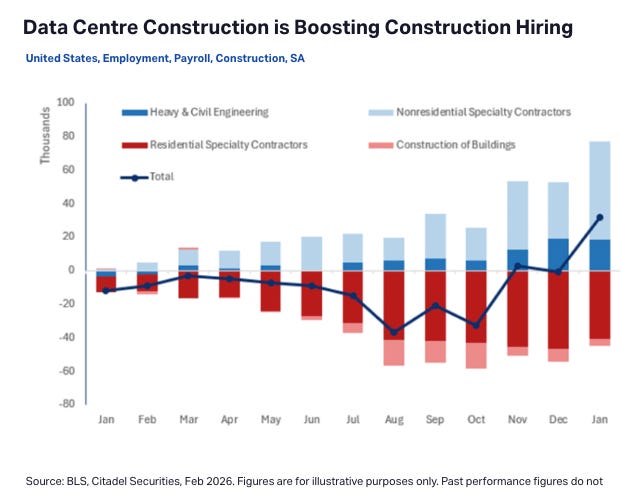
Data centers have created a run on specialty contractors and engineers, but elsewhere, construction employment is pretty tepid.
Bigger picture though, a “jobless” boom is basically the only kind of boom we could plausibly expect.
It’s of course not entirely jobless—the workforce is still growing, albeit very slowly, and best-case scenario, the “boom” continues to create enough net-new opportunity to absorb those entrants, and keep unemployment low. That’s just what a lower “breakeven” means.
Step 2: Hire Lawyers and Architects
So far, so good.
There’s even been a moderate uptick in white collar prospects (to my surprise), once you clear out temps and business support services:
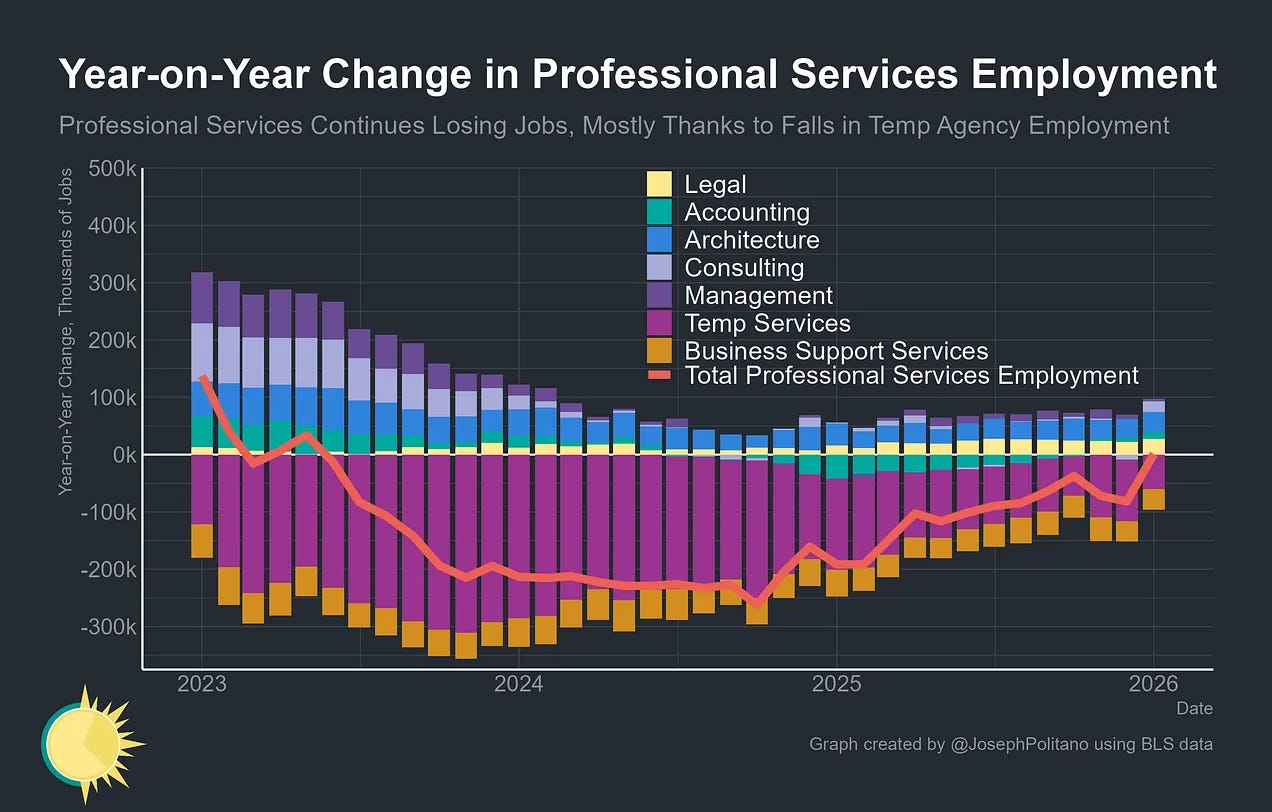
Professional Services employment is on net breakeven, but lawyers, architects, and consultants are getting hired a little more than before.
It’s the temps and support, i.e. lower down the foodchain, that are less in demand, but the white collar folks have a little pep in their step.
Again, that’s pretty good. My guess is that it will ebb and flow, but that’s better than just ebb.
Step 3: Keep it up, but mind the supercore
Where do we go from here?
