

Uncharted waters, blissfully unaware
20+ Charts: Growth without growing is the name of the game, so how're we doing, so far?

the breakeven is now lower
growth is productivity or bust (and that’s not something we’ve ever done before)
the “mystery” of this inflation, not being like the other inflations (“it’s a supercore thing”)
higher wage growth the new normal?
healthcare still makes all the jobs
progress on the deus ex machina ending, aka AI productivity gains
👉👉👉Reminder to sign up for the Weekly Recap only, if daily emails is too much. Find me on twitter, for more fun. 👋👋👋Random Walk has been piloting some other initiatives and now would like to hear from broader universe of you:
(1) 🛎️ Schedule a time to chat with me. I want to know what would be valuable to you.
(2) 💡 Find out more about Random Walk Idea Dinners. High-Signal Serendipity.Uncharted waters, blissfully unaware
Random Walk has demonstrated ad nauseam that the single most important theme going forward is “growth without growing.”
For the uninitiated, some context:
People-growth is hugely important to economic growth, but the ~80 year tailwind is coming to an end. For nearly a century, we’ve been able to drive growth by adding productive people to the mix: more output, more demand, more workers, more shoppers, etc. And when the domestic people-growth engine slowed, we fell back on immigration and globalization (and cheap credit), but still, more people, at-home and abroad.
But, people-growth is no-longer. The failure to babymake has aged the native born population, immigration has reached unsustainable (and zero-sum) levels, and international markets aren’t growing either.
From this point forward, growth is productivity-driven or bust. It’s uncharted waters, and no one really knows whether it can be done, but we’re sure as hell gonna find out.
And it’s funny, because the fact that we’re now growing slowly-to-not-all for the foreseeable future is the biggest economic change in over a century, and most people are barely aware it’s happening, let alone grok the significance.
I mean, sure, they’re starting to notice the side-effects:
no job growth, but no unemployment? check;
an AI “atoms-driven” industrial growth story? sure, that too—can’t have a durable goods, real estate, or retail story without more worker/shoppers/tenants;
healthcare uber alles? yes, of course—old folks consume lots of healthcare;
higher “supercore ex-housing” inflation? with labor in relatively short supply, the high-touch services will have to pay a premium . . . which makes services some combination of more expensive and/or worse (aka “service shrinkflation”).
Simply put, the economy is not getting larger in a very literal sense. Soon there may even be fewer mouths to feed, but especially, wealthy and productive mouths to feed. And that’s a huge deal!
While everyone was banging around about tariffs and the AI-took-my-job nonsense, Random Walk told you the actual biggest thing was the closed border, and Random Walk was right.
The open border was a deflationary growth surge, and unsustainable as it was, once over, it meant that job-and-shopper growth would grind to a halt.
And so it has.
The breakeven is lower now
A lower employment “breakeven” is the new normal now, and people (aka Fed Researchers) are starting to notice (all at once, apparently).1
First, the Dallas Fed says, “uhh, without immigration, the employment breakeven just isn’t a thing anymore.”
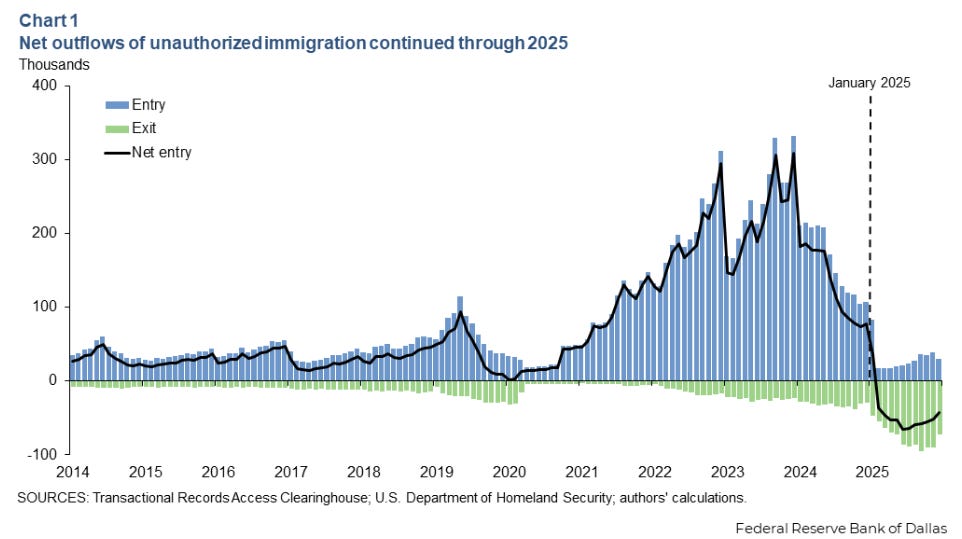
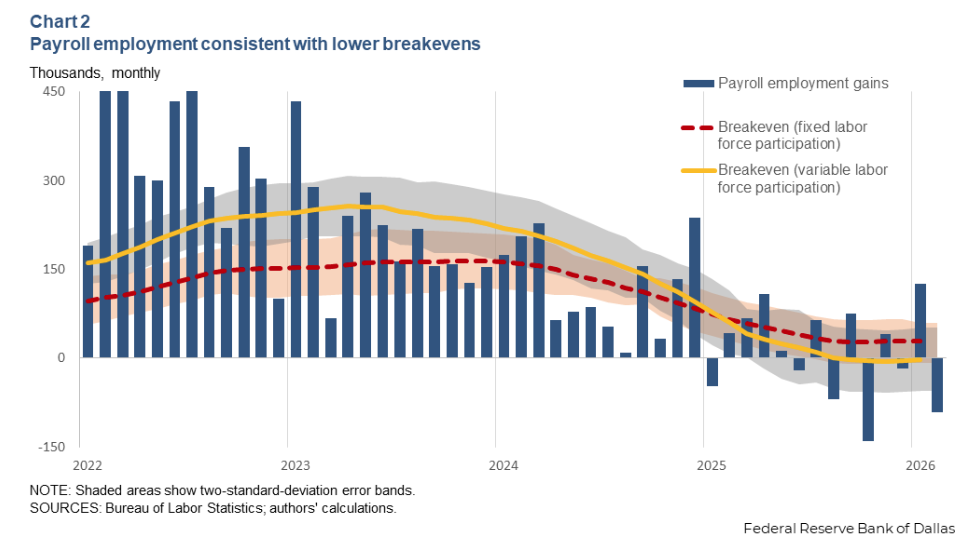
Comparing our break-even estimates with actual payroll growth (Chart 2, blue bars) suggests that job growth over the recent three months—December 2025–February 2026—has slightly exceeded the break-even rate on average, consistent with the unemployment rate remaining stable despite softer headline payroll numbers.
Real-time data point to an important change in the U.S. labor market: The benchmark for evaluating payroll growth has moved significantly. As net outflows of unauthorized immigrants reduced employment growth in late 2025, payroll gains that might historically have signaled economic slack are now consistent with a balanced labor market.
At this point, slow job growth says very little about the economy, other than the fact that the economy is adding very little in the way of potential workers.
The “benchmark” for a ‘good’ jobs print has changed. It’s much, much, lower now.
Along similar lines, and slightly more recently, researchers from the Fed BoG are likewise estimating a labor market breakeven converging on close to zero:
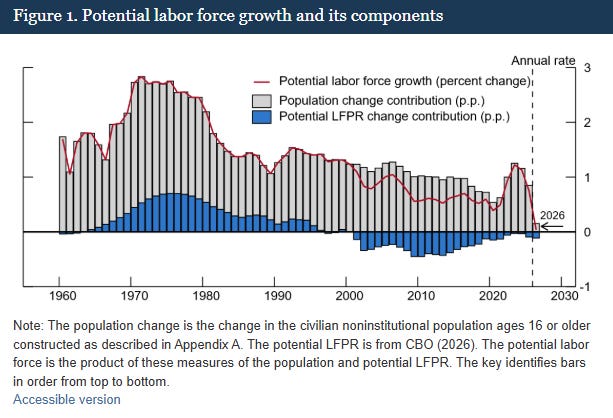
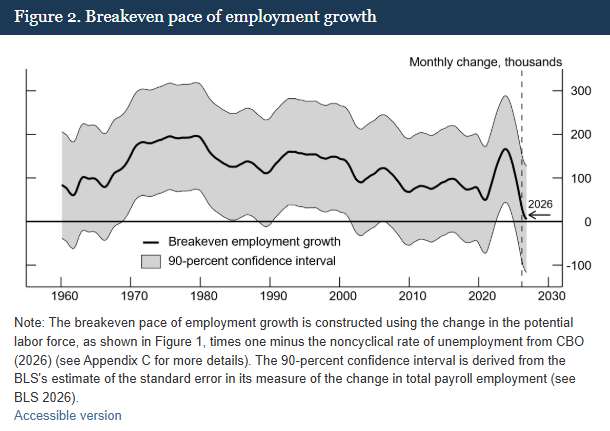
As population growth stalls, and participation rates already near post-GFC highs, there simply aren’t (many) new bodies to add to the labor force, such that it needed them.
The employment breakeven is now lower than its been in the entire series (going back to the 1960s).
Yes, this time it really is different!
When someone sounds alarm bells about a “bad” jobs print because tariffs or AI or whatever, grab ‘em by the collar and holler “well, what the hell else would you expect?!”
Or, more politely:
One important implication of a near-zero breakeven pace is that, even if the output of the U.S. economy (GDP) is growing at the same pace as potential output (potential GDP), employment growth in any given month is almost as likely to be negative as it is to be positive.
Yes, exactly that. Regardless of what GDP does, job-growth will be little ups and little downs, because there really aren’t too many alternatives.
It will look like this:
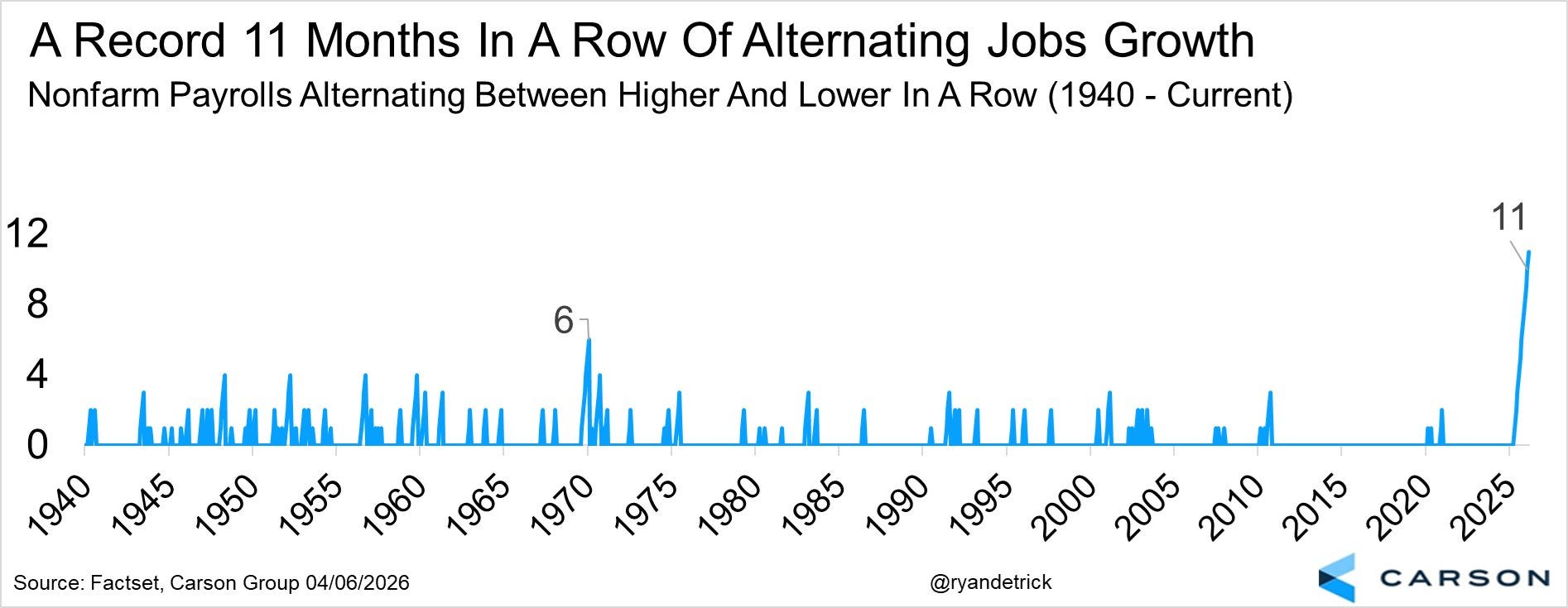
“A record 11 months in a row of alternating jobs-up-jobs-down.”
That’s just how it’s going to be, unless old folks and the youngs start coming off the bench, en masse (or the border is opened again). There just isn’t any other way.
ICYMI


Growth is a productivity story, from here on out
And will it matter?
