
Warsh Doesn’t Want to Be God King, But The Street Still Clamors For Signs and Omens
Thoughts on the new Fed Chair's first kerfuffle

the Fed God King sets aside his crown, and the acolytes are displeased
in some ways, Warsh is already right—the Fed matters less than anyone thinks
Fed mistakes are much worse, and nothing that Warsh said is even the dumbest thing a Fed governor has said recently
if you believe in the ‘AI crowd out’ then you believe the market can do the Fed’s job
a Japanese Coda
👉👉👉Reminder to sign up for the Weekly Recap only, if daily emails is too much. Find me on twitter, for more fun. 👋👋👋Random Walk has been piloting some other initiatives and now would like to hear from broader universe of you:
(1) 🛎️ Schedule a time to chat with me. I want to know what would be valuable to you.
(2) 💡 Find out more about Random Walk Idea Dinners. High-Signal Serendipity.Warsh Doesn’t Want to Be God King, But The Street Still Clamors For Signs and Omens
There’s a new Fed Chair in town, and the commentariat is restless.
What appears most irksome is Warsh’s inclination to do things a bit differently, particularly around how and why the Fed communicates with the public. Allow me to frame this a bit uncharitably, to make the point.1
Pre-Warsh, the Chair was the Oracle of Delphi—the street would breathlessly await FOMC announcements, wondering what fate the gods of monetary policy had determined from on high. Would the Fed be merciful? Would it be wise? Or would it visit its wrath upon the people? The Fed didn’t just move markets, it was the prime-mover, and the Fed could either choose to save us from our maladies, prolong our suffering, or simply be capricious and cruel, like the gods of old.
To be fair, the Fed God King moderated the second-order impact of its power in one key respect: it gave ample guidance as to what it was most likely going to do. An omnipotent Fed, was at least a transparent one. If doom or boom was nigh, it would not be too much of a surprise.
Warsh wants to change all that.
Warsh wants the market to “play the ball, not the referee.”
And market prices will continue to respond in the direction and magnitude they see fit. This is in my view a change for the better, and we’re just getting started. After all, the Central Bank need not always and everywhere be the center of attention.
No more dot-plots or forecasting or prognosticating. Let the market price yields, and let the cure to high prices be high prices. You want guidance? Here’s your guidance: to paraphrase, “we care about inflation—no further comments for today.”
Putting aside the method and/or the execution, there’s a lot to be said for Warsh’s new regime.
The Fed is not, and probably should not, be the Economy God King.
The Fed’s interventions, e.g. loading up its own balance sheet with low-yield mortgages and government debt, are not costless—they may delay the pain-trade, but they do not make it go away (and arguably they make it considerably worse).
There should be no “fed put,” and if monetary policy is not the problem, then monetary policy should not be the solution.
Remember that markets do not “overheat.” Central bankers and fiscal policymakers, on the other hand, most definitely overheat—for the latter, it’s basically a feature—but markets are self-correcting. So, if Warsh’s crusade is to say “stop treating the Fed like a god king,” then his inclination is right (even if pulling it off, and at what cost, is a separate question).
But, the Fed God King acolytes are displeased.
“But, you are the ball, my liege!” they cry. “Appoint a fed chair king for us, to govern us like all other nations . . . let our king judge us, and go out before us, and fight our battles . . . for if you will not guide the economy, then how will the economy know which way to turn?! We will follow no other master but you!”2
More charitably, the criticism is really a restatement of the problem that Warsh is trying to solve: everything we know about “Fed Credibility” is tied to the Fed giving a clear signal to credit markets about what the Fed is going to do, and Warsh is trying to break that:
The Fed needs a “reaction function,” (i.e. here’s our goal, here’s how we’ll know if the goal is met, and here’s what we’re likely to do, if not). If the Fed doesn’t do that, then it’s no longer credible (as we’ve understood it).
This new regime introduces all kinds of uncertainty—credit markets are going to have to try and anticipate the Fed, and each other. There might be more volatility, as a result. The entire business of a Treasury trader has been upended—they’re still going to do the same thing, only worse.
Maybe so, but to that, Warsh would say “that’s the point—don’t react to us, we’ll react to you.”3
Now, given how important the Fed has been (or perceived to have been), there’s a lot to be said for predictability. It’s a good argument—probably the best argument—in favor of the status quo ante. The upside of being told what to do and what will happen is that there is far less uncertainty about what to do and what will happen. And, as we all know, uncertainty makes markets go something-something.4
But, if you think that the Fed God King is nonetheless bad, and that all that certainty has a cost, then you also may think that all the tradeoffs of a more decentralized price-setting function are worth it (for all the reasons that decentralized price-setting functions are generally considered worth it).5
Maybe that’s wrong in this case—or maybe the Fed is, by definition, the God King, whether it wants the crown or not—but howling at Warsh “what have you done—now we have less perfect information about how to price treasuries!” is preaching to the converted. Yes, he knows that you’re confused. That’s the point. Warsh wants you to go figure it out. If you think that supply is in excess of demand, then don’t smash that bid, until the price is right. Then he’ll decide whether to act or not, but he’s not gonna tell you ahead of time. Learn to fish, man.
Will it work? Is the old equilibrium too sticky to change? Is the Fed the elephant, and tip-toeing like a mouse, merely a charade? Will traders be Fed Guessing anyway, but just less accurately than before (and is that bad)? All good questions. Idk the answers, and I doubt anyone else does, either.
ICYMI


Warsh is already right (in at least one sense)
In some ways, though, Warsh is already right. The Fed’s dot-plot isn’t what it used to be.
The Fed has far less control over interest rates (let alone the economy) than people would like to think.
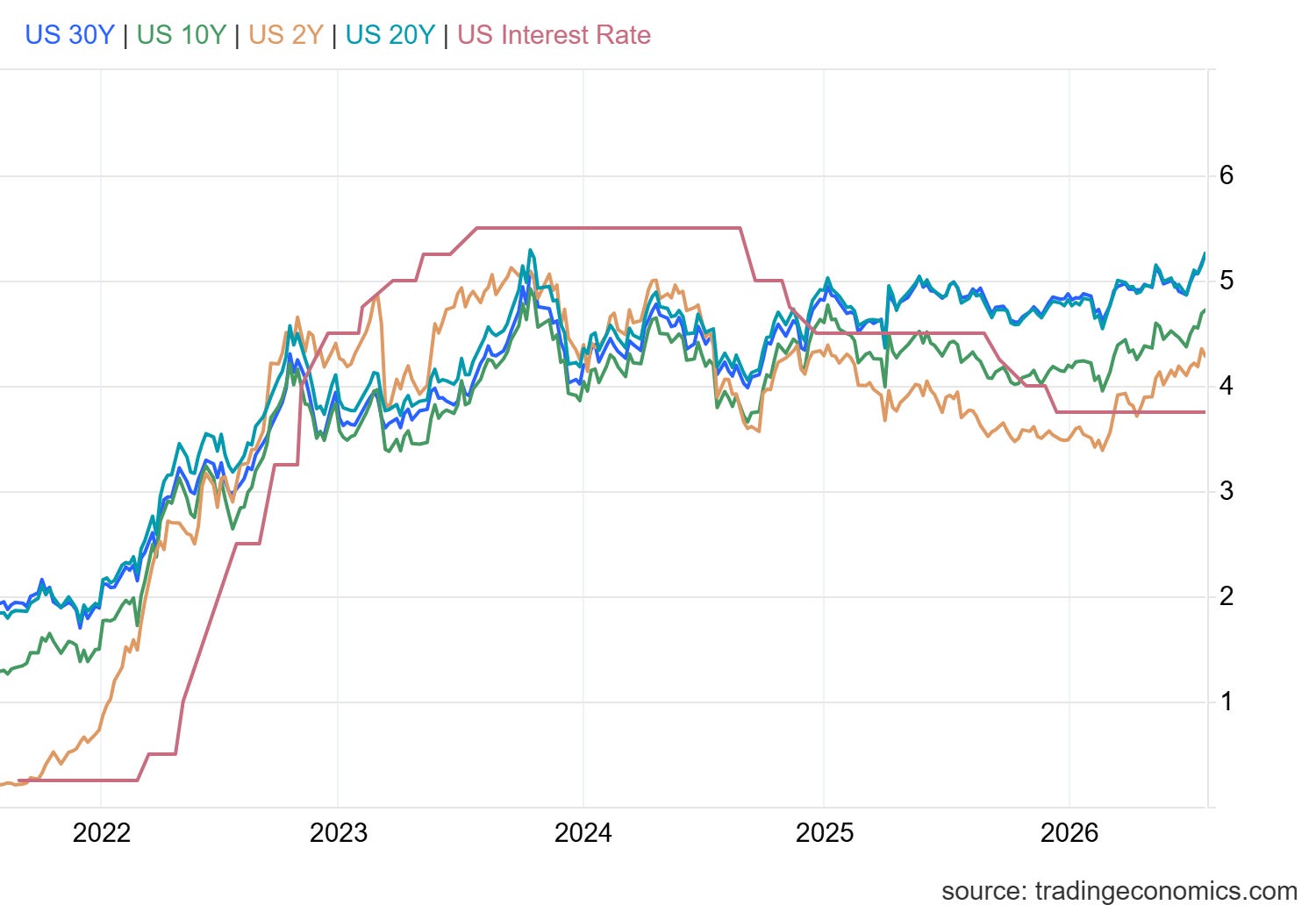
The long end of the curve is determined by supply-and-demand—which the Fed can influence with the heft of its balance sheet, but rate-setting? Not so much.
Did longer-term yields wiggle even more after Warsh’s FOMC? Sure—which I suspect Warsh would view as a success—but the reality is that the 30 year has been awfully high since 2025 (and spreads between long and short have been wide since then, as well).
You see, it’s fiscal policy and demographics that are driving this train, whether the Fed likes it or not. There’s only one over-heating spender, and it’s Uncle Sam (and the lesser God Kings):
